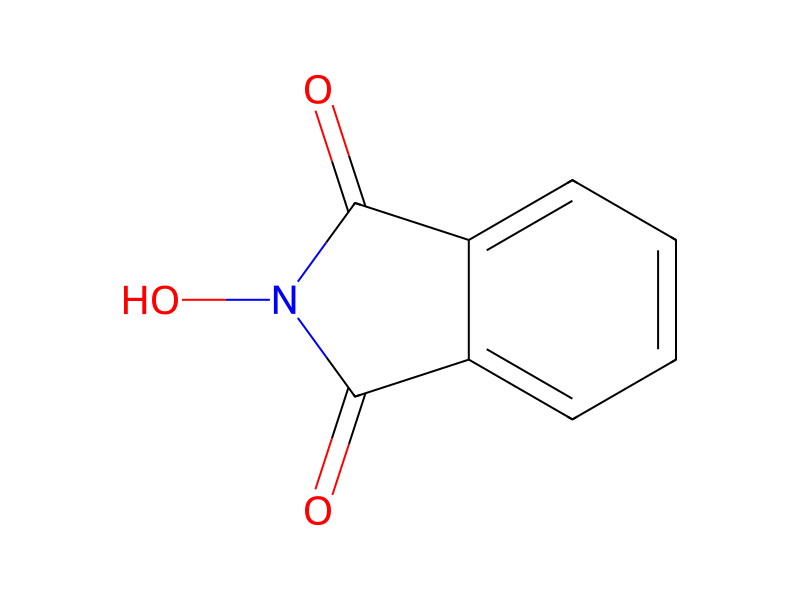
[C:1]([Si:5]([C:18]1[CH:23]=[CH:22][CH:21]=[CH:20][CH:19]=1)([C:12]1[CH:17]=[CH:16][CH:15]=[CH:14][CH:13]=1)[O:6][CH2:7][CH2:8][CH2:9][CH2:10][OH:11])([CH3:4])([CH3:3])[CH3:2].C1(P(C2C=CC=CC=2)C2C=CC=CC=2)C=CC=CC=1.O[N:44]1[C:48](=[O:49])[C:47]2=[CH:50][CH:51]=[CH:52][CH:53]=[C:46]2[C:45]1=[O:54].N(C(OCC)=O)=NC(OCC)=O>O1CCCC1>[C:1]([Si:5]([C:12]1[CH:17]=[CH:16][CH:15]=[CH:14][CH:13]=1)([C:18]1[CH:23]=[CH:22][CH:21]=[CH:20][CH:19]=1)[O:6][CH2:7][CH2:8][CH2:9][CH2:10][O:11][N:44]1[C:48](=[O:49])[C:47]2[C:46](=[CH:53][CH:52]=[CH:51][CH:50]=2)[C:45]1=[O:54])([CH3:4])([CH3:2])[CH3:3]4-(tert-Butyl-diphenyl-silanyloxy)-butan-1-ol (10.0 g, 30.5 mmol), triphenylphosphine (8.0 g, 30 mmol), and N-hydroxyphthalimide (4.97 g, 30.5 mmol) were combined in anhydrous tetrahydrofuran (200 ml) att 0° C. and the resultant solution was stirred at 0° C. for 1 hour. Diethyl azodicarboxylate (5.31 g, 30.5 mmol) was added at 0° C., and the reaction mixture was allowed to gradually warm to room temperature and stirred overnight. The reaction mixture was concentrated under reduced pressure and the residue was dissolved in chloroform. Precipitation ensued, and the white solid was removed by filtration. The filtrate was concentrated and purified with column chromatography (hexane/ethyl acetate (3/1)) to afford 2-[4-(tert-butyl-diphenyl-silanyloxy)-butoxy]-isoindole-1,3-dione (11.06 g, 77% yield) as colorless crystals: 1H NMR (400 MHz, DMSO-d6) δ 7.84 (4H, s), 7.59 (4H, dd, J=7.6, 1.0 Hz), 7.39-7.43 (6H, m), 4.13 (2H, t, J=6.4 Hz), 3.68 (2H, t, J=5.8 Hz), 1.67-1.78 (4H, m), 0.95 (9H, s).
Loading…