HomeMCPWorkbenchSkills
HomeWorkbenchNotificationsMe
llms.txt · MCP GuidePrivacy Policy · Terms of Service · Supportv1.8.0
  1. Home
  2. /Reaction

4-Fluorophenol → Ammonia

HRID 222347
Notes
Print preview

Reaction equation

HRID 222347 reaction equation
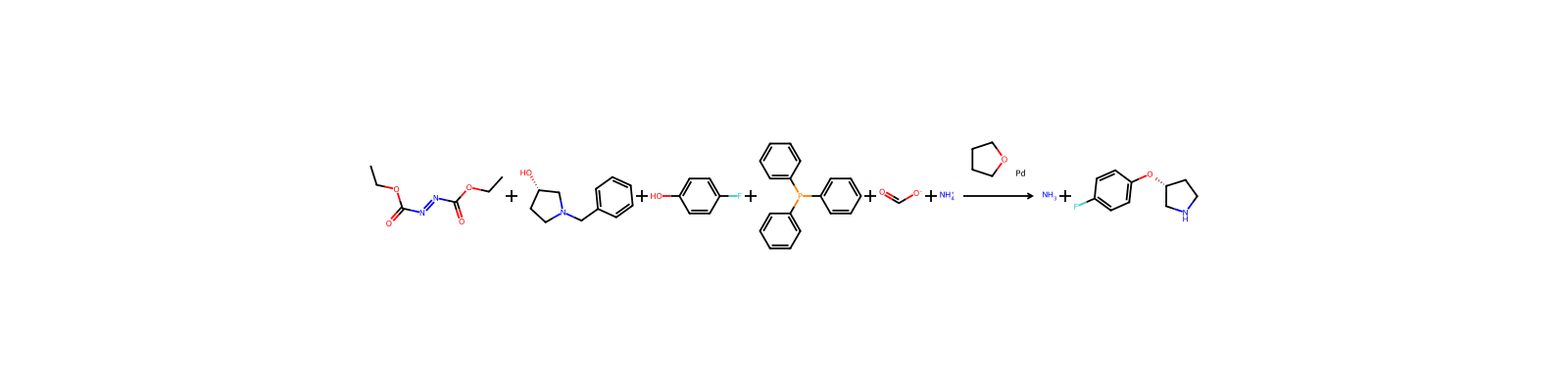
[N:1](C(OCC)=O)=NC(OCC)=O.C([N:20]1[CH2:24][CH2:23][C@H:22]([OH:25])[CH2:21]1)C1C=CC=CC=1.[F:26][C:27]1[CH:32]=[CH:31][C:30](O)=[CH:29][CH:28]=1.C1(P(C2C=CC=CC=2)C2C=CC=CC=2)C=CC=CC=1.C([O-])=O.[NH4+]>O1CCCC1.[Pd]>[NH3:1].[F:26][C:27]1[CH:32]=[CH:31][C:30]([O:25][C@@H:22]2[CH2:23][CH2:24][NH:20][CH2:21]2)=[CH:29][CH:28]=1
ParticipantsProcedureWorkupSources & evidenceReaction notes

Participants

9

Reactant 5

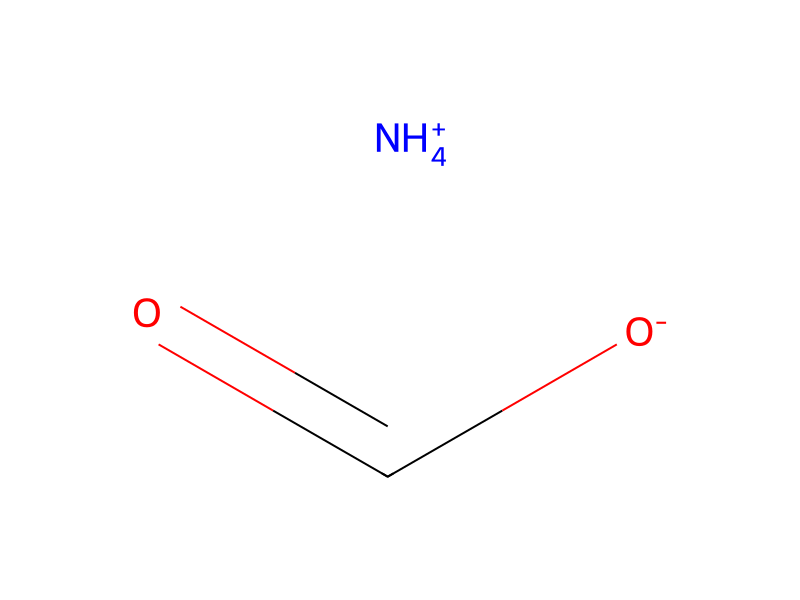
HCID 97324-FluorophenolHCID 11776TriphenylphosphineHCID 220568ethyl N-ethoxycarbonyliminocarbamateHCID 2723923Ammonium formateHCID 2733875(S)-(-)-1-Benzyl-3-pyrrolidinol

Product 2

HCID 222Ammonia
HCID 26192122
(R)-3-(4-Fluorophenoxy)pyrrolidine

Reagents, catalysts & solvents 2

HCID 23938PalladiumCatalystHCID 8028TetrahydrofuranSolvent

Procedure

Diethyl azodicarboxylate (60.5 mL, 384 mmol) was added to an ice-cooled mixture of (S)-(−)-1-benzyl-3-pyrrolidinol (56.72 g, 320 mmol), 4-fluorophenol (39.45 g, 352 mmol) and triphenyl phosphine (100.7 g, 384 mmol) in tetrahydrofuran (500 mL) and the mixture was stirred for 18 hours, allowing the temperature to rise to ambient. The reaction mixture was then concentrated in vacuo and the residue was taken up in pentane:dichloromethane, 90:10. The resulting precipitate was filtered off and the filtrate was concentrated in vacuo. The residue was then purified by column chromatography on silica gel, eluting with dichloromethane. The appropriate fractions were evaporated under reduced pressure and a portion of the residue (5 g) was dissolved in methanol (100 mL). 10% Pd/C (0.5 g) and ammonium formate (5.8 g, 92 mmol) were added and the mixture was stirred at room temperature for 3 hours. The mixture was then filtered through Arbocel® and the filtrate was concentrated in vacuo purified by column chromatography on silica gel, eluting with dichloromethane; methanol, 0.88 ammonia, 95:5:0.5 to 90:10:1, to afford the title compound as a colourless oil. 1H NMR (400 MHz, DMSO-d6) δ: 2.03 (m, 2H), 3.10-3.29 (m, 3H), 3.36 (m, 1H), 5.01 (m, 1H), 6.96 (m, 2H), 7.08 (m, 2H).
Workup

  1. temperaturecooled
  2. concentrationThe reaction mixture was then concentrated in vacuo
  3. filtrationThe resulting precipitate was filtered off
  4. concentrationthe filtrate was concentrated in vacuo
  5. customThe residue was then purified by column chromatography on silica gel
  6. washeluting with dichloromethane
  7. customThe appropriate fractions were evaporated under reduced pressure
  8. dissolutiona portion of the residue (5 g) was dissolved in methanol (100 mL)
  9. stirringthe mixture was stirred at room temperature for 3 hours
  10. filtrationThe mixture was then filtered through Arbocel®
  11. concentrationthe filtrate was concentrated in vacuo
  12. custompurified by column chromatography on silica gel
  13. washeluting with dichloromethane

Sources & evidence

ORD record
ord-0d16e6558bbb4e03bd9c7994bb2b1202
Source dataset
uspto-grants-2012_06
DOI
10.6084/m9.figshare.5104873.v1
Patent number
US08207198B2

Reaction notes

Loading…

On this pageParticipantsProcedureWorkupSources & evidenceReaction notes