HomeMCPWorkbenchSkills
HomeWorkbenchNotificationsMe
llms.txt · MCP GuidePrivacy Policy · Terms of Service · Supportv1.8.3
  1. Home
  2. /Reaction

Dimethylformamide → N,N-diethyl-2-fluoroisonicotinamide

HRID 2273656
Print

Reaction equation

HRID 2273656 reaction equation
[F:1][C:2]1[CH:3]=[C:4]([CH:8]=[CH:9][N:10]=1)[C:5]([OH:7])=O.CN(C)C=O.S(Cl)(Cl)=O.[CH2:20]([NH:22][CH2:23][CH3:24])[CH3:21]>ClCCl.O1CCCC1>[CH2:20]([N:22]([CH2:23][CH3:24])[C:5](=[O:7])[C:4]1[CH:8]=[CH:9][N:10]=[C:2]([F:1])[CH:3]=1)[CH3:21]
ParticipantsProcedureWorkupSources & evidenceReaction notes

Participants

7

Reactant 4

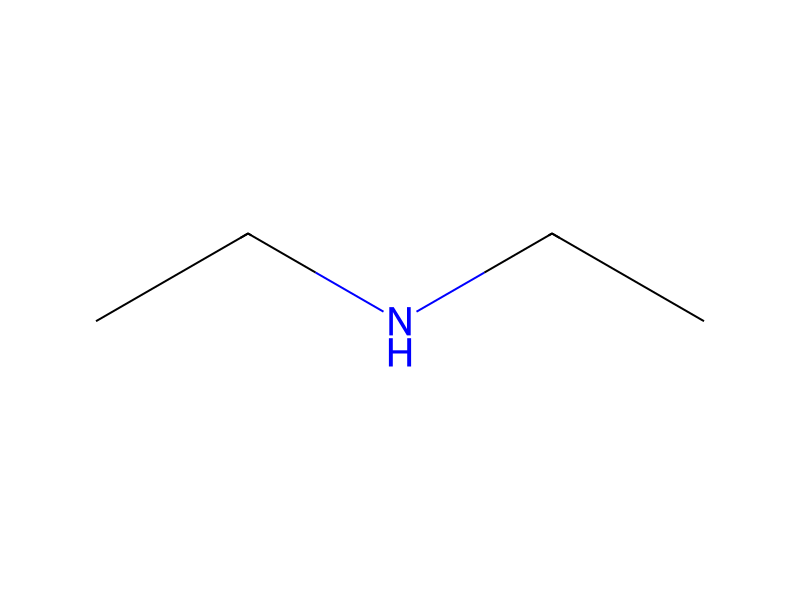
HCID 6228DimethylformamideHCID 8021DiethylamineHCID 24386Thionyl ChlorideHCID 3453602-Fluoroisonicotinic acid

Product 1

HCID 52952053N,N-diethyl-2-fluoroisonicotinamideYield 68%

Reagents, catalysts & solvents 2

HCID 6344
Dichloromethane
Solvent
HCID 8028TetrahydrofuranSolvent

Procedure

To a stirred suspension of compound 27 (6.00 g, 42.5 mmol) in anhydrous dichloromethane (200 mL) were successively added, under argon, anhydrous N,N-dimethylformamide (2 mL) and thionyl chloride (12.4 mL, 0.17 mol). The mixture was refluxed for 3 h. After cooling to room temperature, the solvent was evaporated under reduce pressure and the residue was dissolved in anhydrous toluene (40 mL). The solvent was evaporated under vacuum and the residue was dissolved in anhydrous tetrahydrofuran (40 mL). A solution of diethylamine (8.79 mL, 85.0 mmol) in anhydrous tetrahydrofuran (10 mL) was added dropwise, at 0° C. The mixture was then stirred at room temperature for 12 h. The solvent was evaporated under reduce pressure and the residue was dissolved in water (80 mL) before addition of a 5% aqueous sodium carbonate solution (10 mL). The mixture was extracted with dichloromethane (4×80 mL). The organic layers were combined, dried on magnesium sulfate, filtered and evaporated under vacuum. The residue was chromatographed (Al2O3, AcOEt) to give compound 86 (5.66 g, 28.8 mmol) as a yellow liquid. Yield 68%; Rf (Al2O3, AcOEt) 0.78; IR (CCl4) ν 1298, 1401, 1433, 1562, 1612, 1647, 2936, 2978 cm−1: 1H NMR (200 MHz, CDCl3) δ 1.00 (t, 3H, J=7.1 Hz), 1.12 (t, 3H, J=7.1 Hz), 3.09 (q, 2H, J=7.1 Hz), 3.42 (q, 2H, J=7.1 Hz), 6.80 (m, 1H), 7.05 (ddd, 1H, 5JH-F=1.9 Hz, J=1.3, 5.1 Hz), 8.15 (d, 1H, J=5.1 Hz); MS m/z 196 (M+, 22), 195 (26), 124(100), 96 (36), 76 (11), 69 (12).


Workup

  1. additionwere successively added, under argon
  2. temperatureThe mixture was refluxed for 3 h
  3. customthe solvent was evaporated
  4. dissolutionthe residue was dissolved in anhydrous toluene (40 mL)
  5. customThe solvent was evaporated under vacuum
  6. dissolutionthe residue was dissolved in anhydrous tetrahydrofuran (40 mL)
  7. customThe solvent was evaporated
  8. dissolutionthe residue was dissolved in water (80 mL) before addition of a 5% aqueous sodium carbonate solution (10 mL)
  9. extractionThe mixture was extracted with dichloromethane (4×80 mL)
  10. customdried on magnesium sulfate
  11. filtrationfiltered
  12. customevaporated under vacuum
  13. customThe residue was chromatographed (Al2O3, AcOEt)

Sources & evidence

ORD record
ord-b24dd2de7875479f839ff1fefdd2326a
Source dataset
uspto-grants-2015_09
DOI
10.6084/m9.figshare.5104873.v1
Patent number
US09125937B2

Reaction notes

On this pageParticipantsProcedureWorkupSources & evidenceReaction notes