Reaction equation

[OH-].[Na+].[NH:3]1[C:11]2[C:6](=[CH:7][CH:8]=[CH:9][CH:10]=2)[CH:5]=[CH:4]1.[OH-].C([N+](CCCC)(CCCC)CCCC)CCC.[C:30]([N:33]1[CH2:42][CH2:41][C:40]2[C:35](=[CH:36][C:37]([S:43](Cl)(=[O:45])=[O:44])=[CH:38][CH:39]=2)[CH2:34]1)(=[O:32])[CH3:31]>O1CCCC1>[N:3]1([S:43]([C:37]2[CH:36]=[C:35]3[C:40]([CH2:41][CH2:42][N:33]([C:30](=[O:32])[CH3:31])[CH2:34]3)=[CH:39][CH:38]=2)(=[O:44])=[O:45])[C:11]2[C:6](=[CH:7][CH:8]=[CH:9][CH:10]=2)[CH:5]=[CH:4]1Participants
Reactant 4
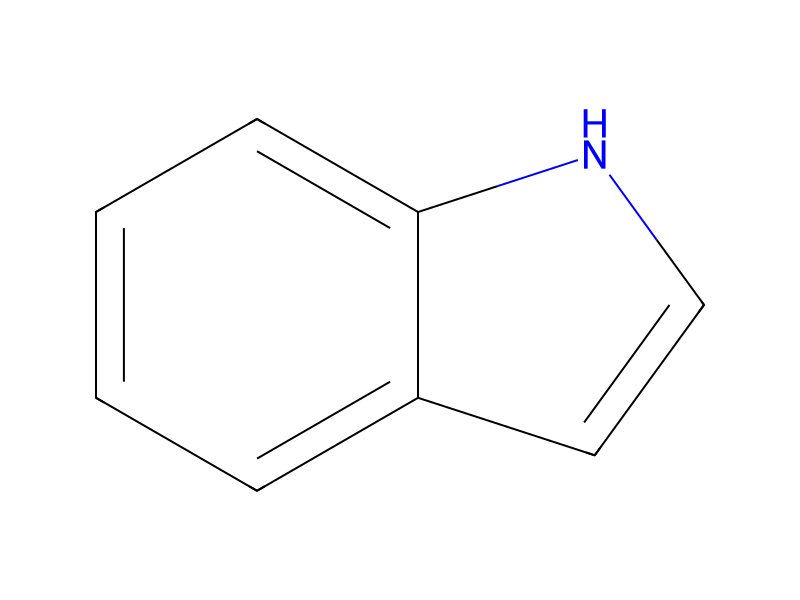



Product 1

Reagents, catalysts & solvents 1

Procedure
A 50% solution of sodium hydroxide (100 ml) was added to a vigorously stirred solution of indole (5.8 g, 50 mmol) and tetrabutylammonium hydroxide (40% by weight solution, 2 ml, 3.1 mmol) in tetrahydrofuran (100 ml). After 5 minutes, a solution of 2-acetyl-1,2,3,4-tetrahydroisoquinoline-7-sulfonyl chloride (R. G. Pendleton et al., J. Pharmacol. Exp. Ther., 1979, 208, 24; U.S. Pat. No. 3,725,388 (1973)) (13.7 g, 50 mmol) in tetrahydrofuran (50 ml) was added over 10 minutes and the resulting mixture was vigorously stirred for a further 3 h. The mixture was then extracted with ethyl acetate (250 ml) and the extract dried (MgSO4), concentrated in vacuo and the residue purified by column chromatography over silica gel eluting with a dichloromethane/methanol gradient to give the title compound (D1) (12.8 g, 72%), NMR (CDCl3; rotamers observed)/ppm 2.12, 2.14 (3H, 2×s), 2.77-2.88 (2H, m), 3.60, 3.74 (3H, 2×t J=7 Hz), 4.59, 4.68 (2H, 2×s), 6.65-6.67 (1H, m), 7.16-7.34 (3H, m), 7.50-7.69 (4H, m), 7.94-7.99 (1H, m); MS: m/z (MH+) 355.
Workup
- extractionThe mixture was then extracted with ethyl acetate (250 ml)
- dry with materialthe extract dried (MgSO4)
- concentrationconcentrated in vacuo
- customthe residue purified by column chromatography over silica gel eluting with a dichloromethane/methanol gradient
Sources & evidence
- ORD record
- ord-14f05329adb54f16b989eb56a01c6cfa
- Source dataset
- uspto-grants-2005_02
- Patent number
- US06849644B2
Linked notes
Loading…