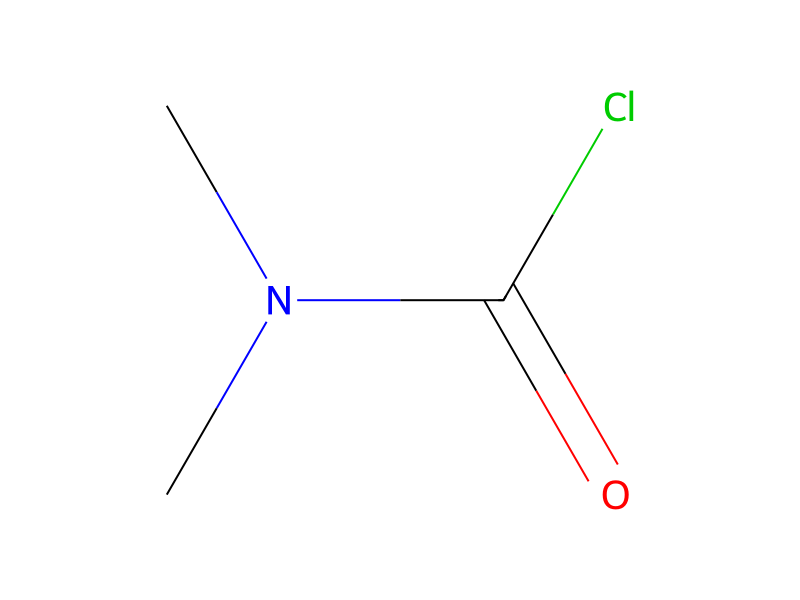
3.0 g (0.019 mol) of 5-oxo-2,2,4-trimethyl-3-thiazoline oxime are added portionwise to a suspension of 0.9 g of sodium hydride in 20 ml of tetrahydrofuran. The sodium hydride was liberated shortly before its use from a 55% suspension in oil by two-fold extraction with a small amount of absolute pentane. After completion of the hydrogen evolution, the mixture is stirred at room temperature for an additional 1 hour. 2.05 g (0.019 mol) of dimethylcarbamoyl chloride are added dropwise, and the reaction mixture is stirred at room temperature for 16 hours. The residue is then taken up in diethyl ether, and the organic phase is washed with saturated sodium chloride solution and dried over anhydrous sodium sulfate. The solvent is subsequently distilled off, and the residue is recrystallized from diethyl ether/n-hexane to yield 5-oxo-2,2,4-trimethyl-3-thiazoline O-(dimethylcarbamoyl) oxime, m.p. 92°-95° C.