Reaction equation
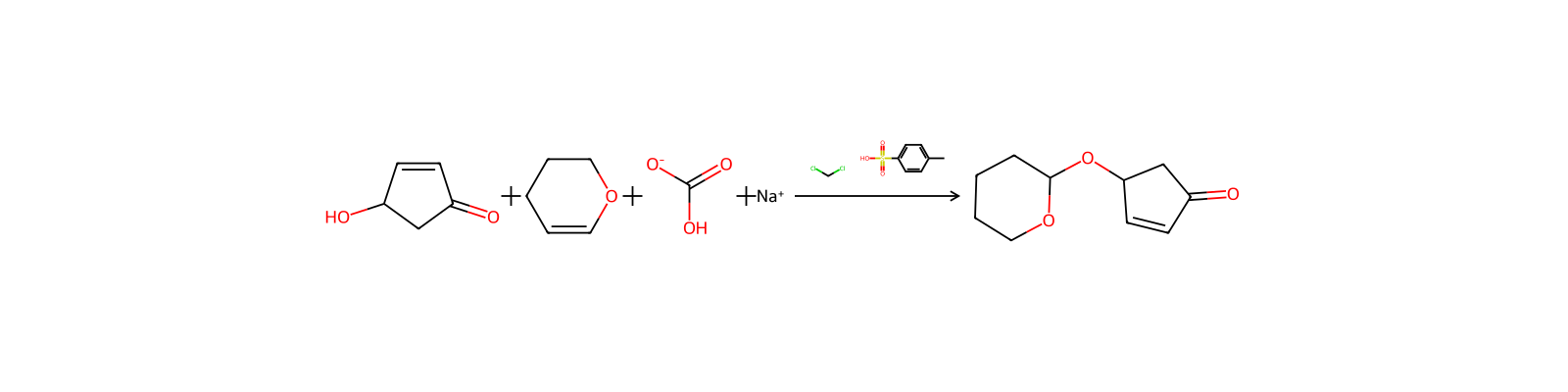
[OH:1][CH:2]1[CH2:6][C:5](=[O:7])[CH:4]=[CH:3]1.[O:8]1[CH:13]=[CH:12][CH2:11][CH2:10][CH2:9]1.C(=O)([O-])O.[Na+]>ClCCl.C1(C)C=CC(S(O)(=O)=O)=CC=1>[O:8]1[CH2:13][CH2:12][CH2:11][CH2:10][CH:9]1[O:7][CH:5]1[CH2:6][C:2](=[O:1])[CH:3]=[CH:4]1Participants






Procedure
In 300 ml of dichloromethane was dissolved 10 g of 4-hydroxy-2-cyclopentenone. To the solution were added 25.7 g of dihydropyran and 0.5 g of p-toluenesulfonic acid, and the mixture was stirred at room temperature for 45 minutes. The reaction solution was poured into an aqueous solution of sodium hydrogencarbonate. The organic layer was separated. The aqueous layer was further extracted with dichloromethane. The organic layers were combined, washed with a saturated aqueous saline solution, then dried (Na2SO4). The solvent was evaporated off, and the residue was subjected to a silica gel column chromatography, followed by elution with hexane--ethyl acetate (7:3) to give 17.4 g of 4-(2-tetrahydropyranyl)oxy-2-cyclopentenone as an oily product.
Workup
- customThe organic layer was separated
- extractionThe aqueous layer was further extracted with dichloromethane
- washwashed with a saturated aqueous saline solution
- dry with materialdried (Na2SO4)
- customThe solvent was evaporated off
- washfollowed by elution with hexane--ethyl acetate (7:3)
Sources & evidence
- ORD record
- ord-71408589cb3444fbb85df478f0348ffe
- Source dataset
- uspto-grants-1989_07
- Patent number
- US04851422
Linked notes
Loading…