Reaction equation
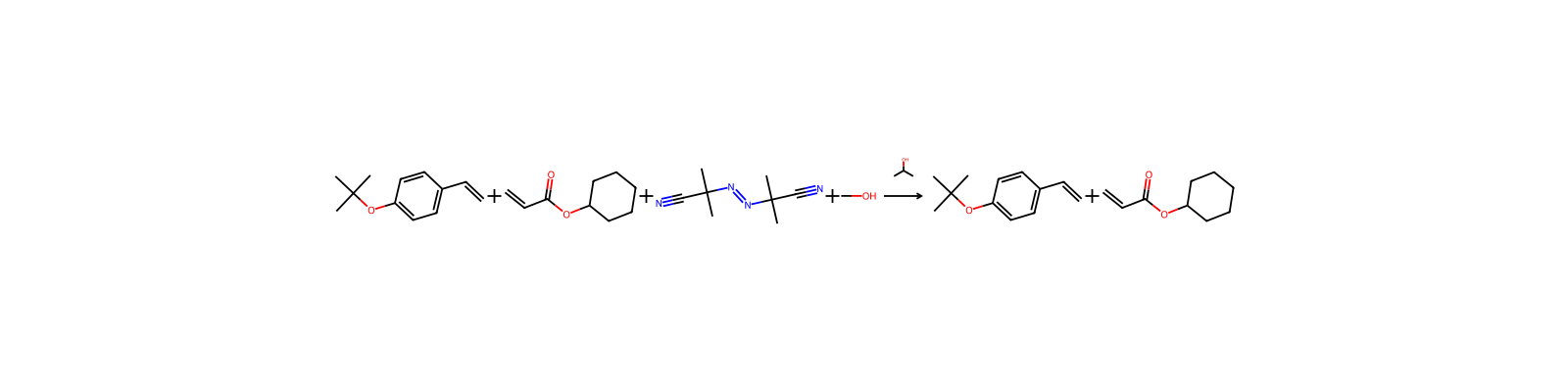
[C:1]([O:5][C:6]1[CH:13]=[CH:12][C:9]([CH:10]=[CH2:11])=[CH:8][CH:7]=1)([CH3:4])([CH3:3])[CH3:2].[C:14]([O:18][CH:19]1[CH2:24][CH2:23][CH2:22][CH2:21][CH2:20]1)(=[O:17])[CH:15]=[CH2:16].N(C(C)(C)C#N)=NC(C)(C)C#N.CO>C(O)(C)C>[C:1]([O:5][C:6]1[CH:7]=[CH:8][C:9]([CH:10]=[CH2:11])=[CH:12][CH:13]=1)([CH3:4])([CH3:2])[CH3:3].[C:14]([O:18][CH:19]1[CH2:24][CH2:23][CH2:22][CH2:21][CH2:20]1)(=[O:17])[CH:15]=[CH2:16]Participants
6
Reactant 4




Product 1

Reagents, catalysts & solvents 1

Conditions
- Temperature
- 75 °C
Procedure
First, 176.3 g (1.0 mol) of p-tert-butoxystyrene and 16.2 g (0.105 mol) of cyclohexyl acrylate were dissolved in 250 ml of isopropanol. In a nitrogen stream, 2,2′-azobisisobutyronitrile was added to the solution, and agitated at 75° C. for six hours. The reaction liquid was cooled, and poured in 5000 ml of an aqueous solution of methanol, thereby precipitating a reaction product. The precipitated solid was collected by filtration, washed with methanol, and dried in vacuum. Thus, 172.5 g of poly(p-tert-butoxystyrene/cyclohexyl acrylate) was obtained as a white powdery crystal.
Workup
- customThe reaction liquid
- temperaturewas cooled
- customprecipitating a reaction product
- filtrationThe precipitated solid was collected by filtration
- washwashed with methanol
- customdried in vacuum
Sources & evidence
- ORD record
- ord-fd69cfff23654517bbdcb8f85511322a
- Source dataset
- uspto-grants-2014_02
- Patent number
- US08642245B2
Linked notes
Loading…