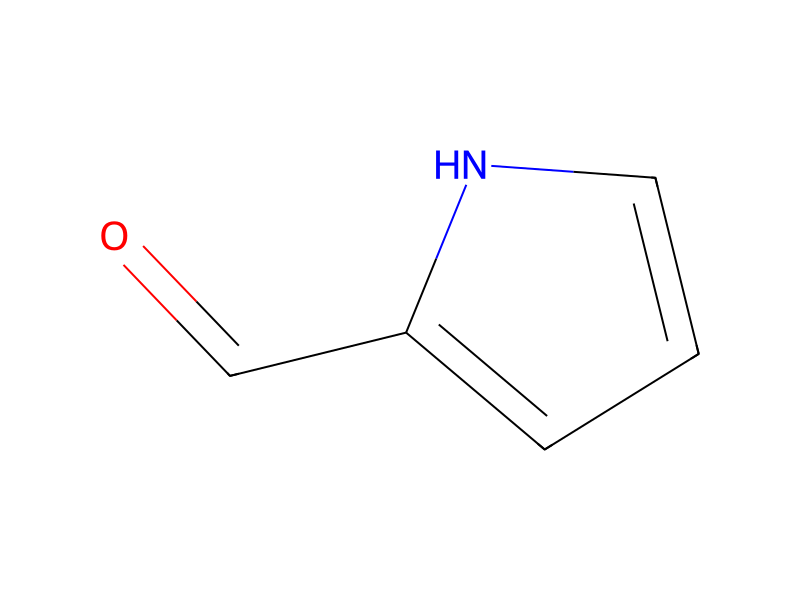
Both formyl-pyrrole derivatives were prepared adopting a procedure described by C. Schmuck, Tetrahedron 2001, 57, 3063: To DMF (1.61 g) was added POCl3 (3.37 g) dropwise under Ar at 0° C. The mixture was allowed to warm to RT after which it was diluted with DCM (11 mL). A solution of 1H-pyrrole-2-carboxylic acid methyl ester (2.51 g) in DCM (11 mL) was added dropwise. The mixture was refluxed for 30 min whereupon it was cooled to 10° C. and quenched with a solution of potassium acetate (10.8 g) in water (28 mL). The phases were separated and the aqueous layer was extracted with MTBE. The combined organic phases were washed with saturated aqueous K2CO3 solution and concentrated in vacuo. The residue was purified by flash column chromatography on silica (ethyl acetate/heptane 1:5) to yield 4-formyl-1H-pyrrole-2-carboxylic acid methyl ester (589 mg) and 5-formyl-1H-pyrrole-2-carboxylic acid methyl ester (1.60 g) as solids.