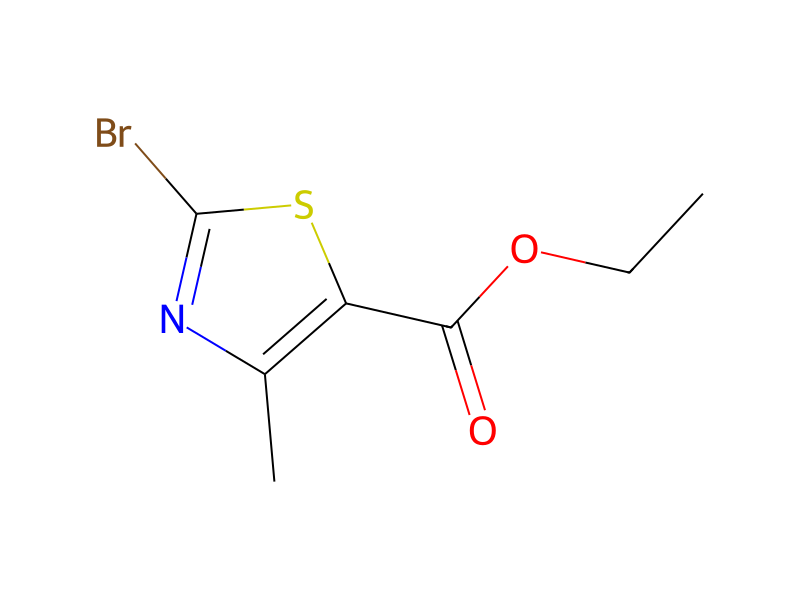
To a solution of ethyl 2-bromo-4-methylthiazole-5-carboxylate (0.50 g, 2.00 mmol) in anhydrous toluene (5 mL) was added copper(I) iodide (0.008 g, 0.040 mmol), dichlorobis(triphenylphosphine)palladium(II) (0.028 g, 0.040 mmol) and N,N-diisopropylethylamine (0.52 mL, 3.00 mmol). The reaction mixture was degassed and the reaction flask was flashed and filled with nitrogen followed by the addition of trimethylsilylacetylene (0.42 mL, 3.00 mmol). The reaction mixture was heated at 40° C. for 5 hours, cooled to ambient temperature, poured onto a silica gel pad and eluted with hexanes and hexanes/ethyl acetate (10/1). The collections were concentrated in vacuo and the obtained clear oil was dissolved in dichloromethane (5 mL) and treated with 10% aqueous sodium hydroxide (0.5 mL) at ambient temperature for 1 hour. The reaction mixture was diluted with dichloromethane (15 mL), washed with water (7 mL) and brine (7 mL). The organic layer was dried over anhydrous sodium sulfate, filtered and concentrated in vacuo to afford the title compound as a yellowish solid (0.31 g, 77%): 1H NMR (300 MHz, CDCl3) δ 4.24 (q, J=7.1 Hz, 2H), 3.53 (s, 1H), 2.63 (s, 3H), 1.27 (t, J=7.1 Hz, 3H); MS (ES+) m/z 196.2 (M+1).