HomeMCPWorkbenchSkills
HomeWorkbenchNotificationsMe
llms.txt · MCP GuidePrivacy Policy · Terms of Service · Supportv1.8.3
  1. Home
  2. /Reaction

1-Chloro-4-iodobenzene → HCID 70914950, compound

HRID 2402350
Print

Reaction equation

HRID 2402350 reaction equation
[Cl:1][C:2]1[CH:7]=[CH:6][C:5](I)=[CH:4][CH:3]=1.C([Mg]Cl)(C)C.[Cl-].[Li+].[CH3:16][CH:17]([CH3:29])[C:18](=[C:20]([C:25]([O:27][CH3:28])=[O:26])[C:21]([O:23][CH3:24])=[O:22])[CH3:19]>C1COCC1.[Cu]I>[Cl:1][C:2]1[CH:7]=[CH:6][C:5]([C:18]([CH:20]([C:25]([O:27][CH3:28])=[O:26])[C:21]([O:23][CH3:24])=[O:22])([CH:17]([CH3:29])[CH3:16])[CH3:19])=[CH:4][CH:3]=1
ParticipantsConditionsProcedureWorkupSources & evidenceReaction notes

Participants

7

Reactant 4

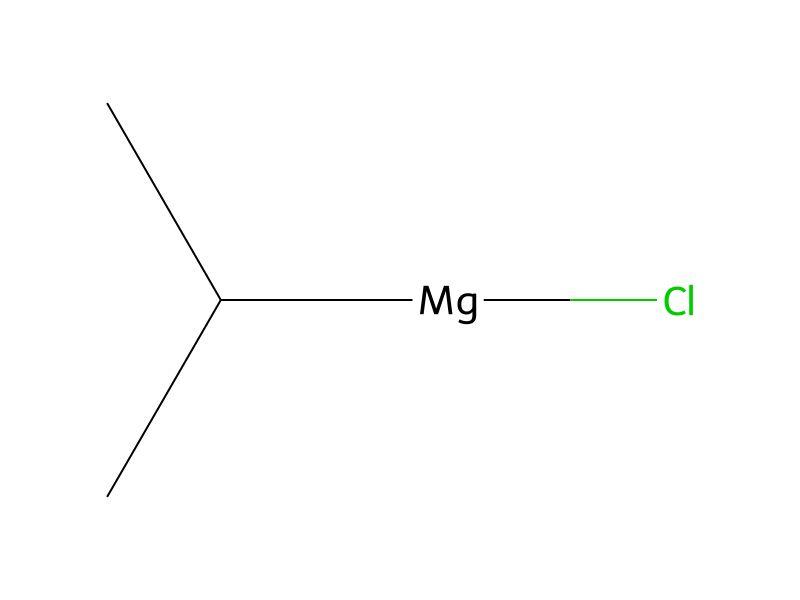
HCID 125101-Chloro-4-iodobenzeneHCID 433294Lithium ChlorideHCID 585743Dimethyl (3-methylbutan-2-ylidene)malonateHCID 178418918HCID 178418918, compound

Product 1

HCID 70914950HCID 70914950, compound

Reagents, catalysts & solvents 2

HCID 24350
Copper(1+) iodide; Copper(I) iodide; Cuprous iodide; Cuprous iodide (CuI)
Catalyst
HCID 8028TetrahydrofuranSolvent3×

Conditions

Temperature
-78 °C

Procedure

Under argon, 6.2 g (26 mmol) of 1-chloro-4-iodobenzene were dissolved in 50 ml of THF and cooled to −78° C. 24 ml (31.2 mmol) of a 1.3 M solution of isopropylmagnesium chloride×lithium chloride in THF were then slowly added dropwise. The reaction solution was then slowly warmed to −40° C. and stirred at this temperature for 2 h. The reaction solution was then warmed to −10° C., and 495 mg (2.6 mmol) of copper(I) iodide were added. 5 g (24.97 mmol) of dimethyl (3-methylbutan-2-ylidene)malonate, dissolved in 30 ml of THF, were then slowly added dropwise to the reaction solution. The resulting reaction mixture was slowly warmed to room temperature and stirred at this temperature for 1 h. The mixture was then cooled to 0° C., and ice-cold 1 M hydrochloric acid (pH˜2) was added carefully. The phases were separated, the aqueous phase was then extracted three more times with ethyl acetate and the combined organic phases were dried over magnesium sulphate, filtered and concentrated to dryness. The resulting crude product was initially pre-purified chromatographically on silica gel (mobile phase cyclohexane/ethyl acetate 20:1). The product was then re-purified by preparative RP-HPLC (mobile phase methanol/water). This gave 3.38 g (42% of theory) of the target compound.

Workup

  1. temperatureThe reaction solution was then slowly warmed to −40° C.
  2. temperatureThe reaction solution was then warmed to −10° C.
  3. additionwere then slowly added dropwise to the reaction solution
  4. customThe resulting reaction mixture
  5. temperaturewas slowly warmed to room temperature
  6. stirringstirred at this temperature for 1 h
  7. temperatureThe mixture was then cooled to 0° C.
  8. customThe phases were separated
  9. extractionthe aqueous phase was then extracted three more times with ethyl acetate
  10. dry with materialthe combined organic phases were dried over magnesium sulphate
  11. filtrationfiltered
  12. concentrationconcentrated to dryness
  13. customThe resulting crude product was initially pre-purified chromatographically on silica gel (mobile phase cyclohexane/ethyl acetate 20:1)
  14. customThe product was then re-purified by preparative RP-HPLC (mobile phase methanol/water)

Sources & evidence

ORD record
ord-ebe8fd68383e4083a1bde54ca004356c
Source dataset
uspto-grants-2014_08
DOI
10.6084/m9.figshare.5104873.v1
Patent number
US08796335B2

Reaction notes

On this pageParticipantsConditionsProcedureWorkupSources & evidenceReaction notes