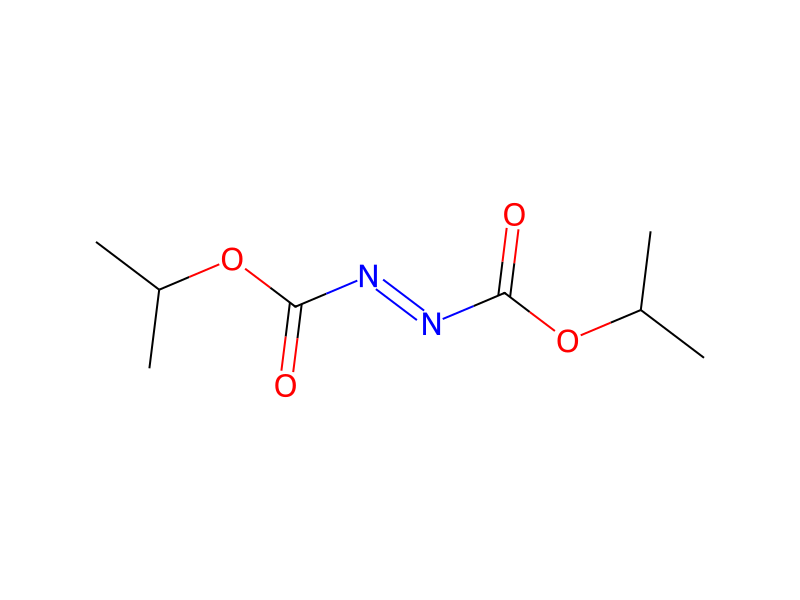
Triphenylphosphine (2.29 g) was dissolved in tetrahydrofuran (50 ml) and the solution was cooled to −10° C. under argon. Diisopropylazodicarboxylate (1.70 ml) was added dropwise over 10 min and the resulting mixture was stirred at −10° C. for 20 min (formation of a white precipitate). 2,2,2-Trifluoro-N-(2-iodo-thiophen-3-yl)-acetamide (2.25 g) dissolved in a minimum volume of tetrahydrofuran was added, followed by 4-Hydroxymethyl-3,6-dihydro-2H-pyridine-1-carboxylic acid tert-butyl ester (J. Org. Chem. 2001, 66, 5545-5551, 1.49 g) dissolved in a minimum volume of tetrahydrofuran. The reaction mixture was allowed to warm to room temperature and stirred for 12 hours. The solution was then concentrated in vacuo and the residue subjected to silica gel chromatography (cyclohexane:ethyl acetate 93:7) to afford 4-{[(2-Iodo-thiophen-3-yl)-(2,2,2-trifluoro-acetyl)-amino]-methyl}-3,6-dihydro-2H-pyridine-1-carboxylic acid tert-butyl ester as a colourless oil (2.27 g). 1H NMR (400 MHz, CDCl3) 1.5 (s, 9H), 2.15 (m, 2H), 3.43 (m, 1H), 3.52 (m 1H), 3.75 (d, J=19 Hz, 1H), 3.77 (m, 2H), 4.76 (d, J=17 Hz, 1H), 5.41 (s, 1H), 6.68 (br d, J=5.5 Hz, 1H), 7.42 (d, J=5.5 Hz, 1H); MS (ES+) 417 (M+H+—CO2-isobutene), 458 (M+H+-isobutene).