Reaction equation
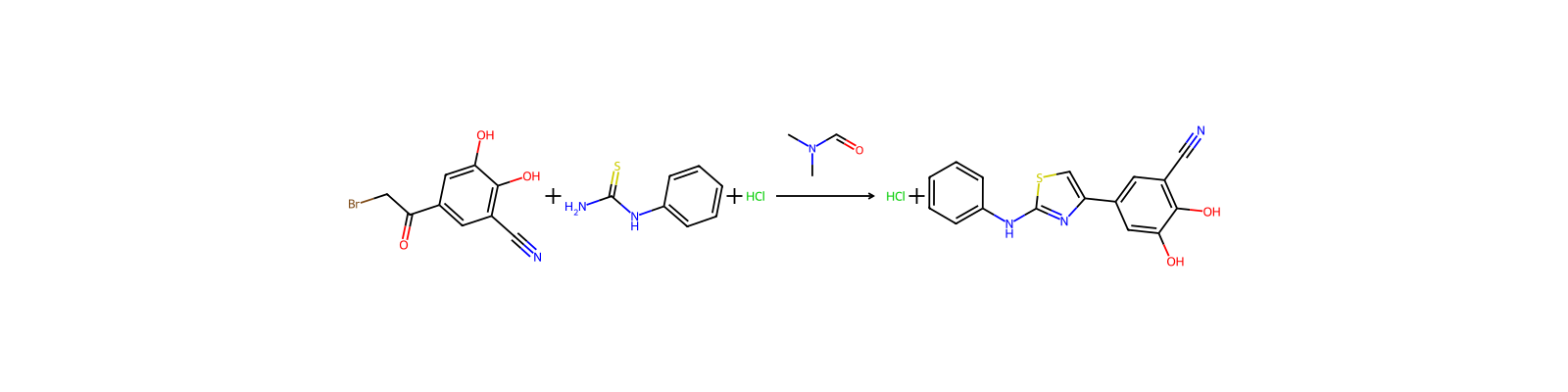
Br[CH2:2][C:3]([C:5]1[CH:6]=[C:7]([OH:14])[C:8]([OH:13])=[C:9]([CH:12]=1)[C:10]#[N:11])=O.[C:15]1([NH:21][C:22]([NH2:24])=[S:23])[CH:20]=[CH:19][CH:18]=[CH:17][CH:16]=1.[ClH:25]>CN(C)C=O>[ClH:25].[NH:21]([C:22]1[S:23][CH:2]=[C:3]([C:5]2[CH:6]=[C:7]([OH:14])[C:8]([OH:13])=[C:9]([CH:12]=2)[C:10]#[N:11])[N:24]=1)[C:15]1[CH:20]=[CH:19][CH:18]=[CH:17][CH:16]=1Participants




Procedure
3.8 g of 5-(bromoacetyl)-2,3-dihydroxybenzonitrile dissolved in 25 ml of N,N-dimethylformamide are treated with N-phenylthiourea and stirred at 100° for 5 hours. Thereafter, the solvent is removed by evaporation. The residue is treated with 200 ml of 1N sodium carbonate solution and extracted three times with 100 ml of methylene chloride each time. The combined organic phases are washed with water, dried over sodium sulfate and evaporated. The residue is chromatographed on 30 g of silica gel with ethyl acetate. The thus-obtained crude product is treated with 40 ml of 1N hydrochloric acid, evaporated and crystallized from acetone. There is obtained 5-(2-anilino-4-thiazolyl)-2,3-dihydroxybenzo- nitrile hydrochloride of m.p. 245°-247°.
Workup
- customThereafter, the solvent is removed by evaporation
- additionThe residue is treated with 200 ml of 1N sodium carbonate solution
- extractionextracted three times with 100 ml of methylene chloride each time
- washThe combined organic phases are washed with water
- dry with materialdried over sodium sulfate
- customevaporated
- customThe residue is chromatographed on 30 g of silica gel with ethyl acetate
- customThe thus-obtained crude product
- customevaporated
- customcrystallized from acetone
Sources & evidence
- ORD record
- ord-9865c62f45bf4d08857121dbab89b3a6
- Source dataset
- uspto-grants-1995_02
- Patent number
- US05389653
Linked notes
Loading…