Reaction equation
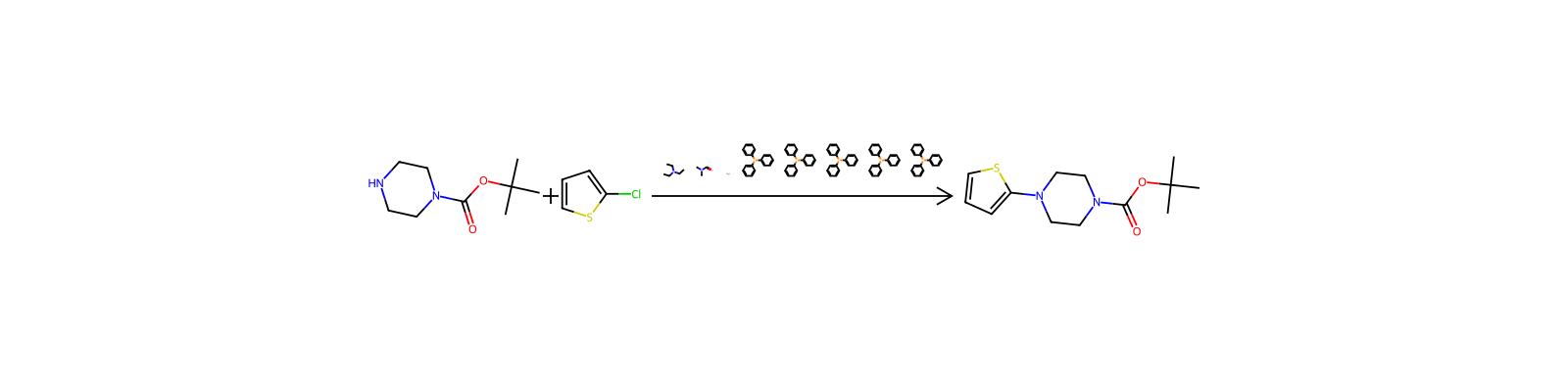
CC(C)(C)OC(=O)N1CCNCC1.Clc1cccs1>CCN(CC)CC.CN(C)C=O.[Pd].c1ccc(P(c2ccccc2)c2ccccc2)cc1.c1ccc(P(c2ccccc2)c2ccccc2)cc1.c1ccc(P(c2ccccc2)c2ccccc2)cc1.c1ccc(P(c2ccccc2)c2ccccc2)cc1.c1ccc(P(c2ccccc2)c2ccccc2)cc1>CC(C)(C)OC(=O)N1CCN(c2cccs2)CC1Participants
7
Reactant 2


Product 1

Reagents, catalysts & solvents 4




Conditions
- Temperature
- 95 °C
Procedure
To a mixture of 2-chlorothiophene (0.248 mL, 2.68 mmol), tert-butyl piperazine-1-carboxylate (500 mg, 2.68 mmol), and TEA (1.123 mL, 8.05 mmol) in DMF (4 mL) was added Pd(Ph3P)4 (57.8 mg, .05 mmol). The reaction was allowed to heat at 95 °C for overnight. LCMS and TLC showed the starting material peak as well as the triphenyl phosphene ionized M+1 peak. The tryphenyl phosphene showed up at the same retention time as 2-chlorothiophene. No new peak was observed following the reaction so no purification techniques were run. MS (m+1) = not seen
Sources & evidence
- ORD record
- ord-37aa4a46f5494844887cf9e7ccaf1b0d
- Source dataset
- 750 AstraZeneca ELN dataset
- Original link
- View source
Linked notes
Loading…