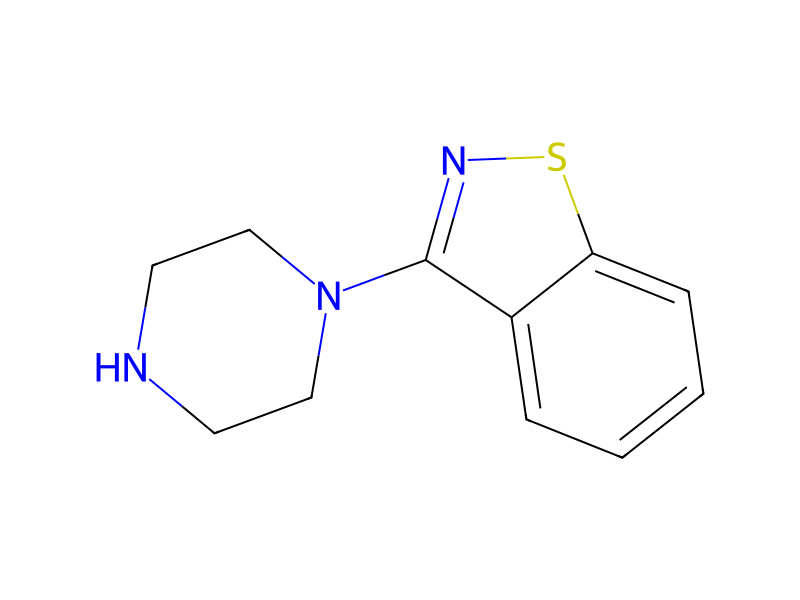
Br.Cl[CH2:3][CH2:4][C:5]1[CH:10]=[CH:9][C:8]([C:11]2[N:12]=[C:13]([NH2:16])[S:14][CH:15]=2)=[CH:7][CH:6]=1.[S:17]1[C:21]2[CH:22]=[CH:23][CH:24]=[CH:25][C:20]=2[C:19]([N:26]2[CH2:31][CH2:30][NH:29][CH2:28][CH2:27]2)=[N:18]1.C(N(C(C)C)CC)(C)C.C(=O)([O-])[O-].[Na+].[Na+].[I-].[Na+]>C(OCC)(=O)C.CC(CC(C)C)=O>[S:17]1[C:21]2[CH:22]=[CH:23][CH:24]=[CH:25][C:20]=2[C:19]([N:26]2[CH2:27][CH2:28][N:29]([CH2:3][CH2:4][C:5]3[CH:10]=[CH:9][C:8]([C:11]4[N:12]=[C:13]([NH2:16])[S:14][CH:15]=4)=[CH:7][CH:6]=3)[CH2:30][CH2:31]2)=[N:18]1To a 50 ml round-bottomed flask equipped with condenser and N2 inlet were added 2.4 g (7.53 mmol) of 4-(4-(2-chloroethyl)phenyl)-2-aminothiazole hydrobromide, 1.65 g (7.53 mmol) of N-(3-benzisothiazolyl) piperazine (prepared according to the method of U.S. Pat. No. 4,411,901), 1.3 ml (7.53 mmol) of diisopropylethylamine, 1.6 g (15.1 mmol) of sodium carbonate, 2 mg of sodium iodide, and 25 ml of methylisobutylketone. The reaction was heated at reflux for 5 days, cooled, evaporated, and taken up in ethyl acetate/water. The ethyl acetate layer was separated, washed with water and brine, dried over sodium sulfate, and evaporated. The residue was chromatographed on silica gel using ethyl acetate as eluent to give a solid. The solid was taken up in hot ethyl acetate, precipitated by addition of hydrochloride gas, the precipitate filtered, washed with ether, and dried to give a beige solid, 1.536 g (38%), m.p. >300° C. (dec.). NMR (DMSO-d6): 3.2-3.8 (m, 10H), 4.1 (m, 2H), 7.25 (s, 1H), 7.4-8.2 (m, 8H), 11.5 (bs, 2H).