Reaction equation

[H-].[Na+].[N+:3]([C:6]1[CH:11]=[CH:10][C:9]([C:12]23[CH2:18][CH:16]([CH2:17]2)[C:15](=[O:19])[NH:14][C:13]3=[O:20])=[CH:8][CH:7]=1)([O-:5])=[O:4].[CH2:21](I)[CH3:22].C(OCC)(=O)C.CCCCCC>CN(C)C=O>[CH2:21]([N:14]1[C:15](=[O:19])[CH:16]2[CH2:17][C:12]([C:9]3[CH:8]=[CH:7][C:6]([N+:3]([O-:5])=[O:4])=[CH:11][CH:10]=3)([CH2:18]2)[C:13]1=[O:20])[CH3:22]Participants
6
Reactant 4


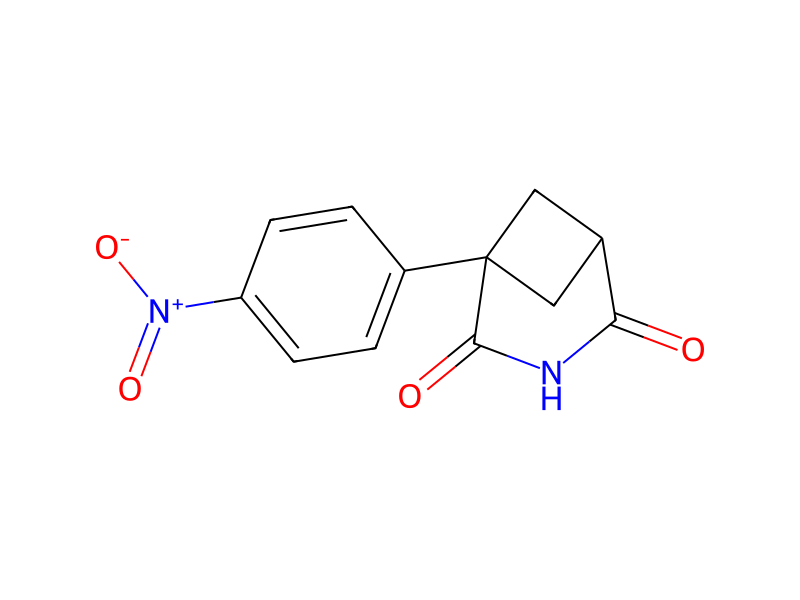

Product 1

Reagents, catalysts & solvents 1

Procedure
0.36 g of sodium hydride is added to a solution of 2.46 g of 1-(4-nitrophenyl)-3-azabicyclo[3.1.1]heptane-2,4-dione in 25 ml of N,N-dimethylformamide and the whole is stirred at room temperature for 30 minutes. 2.33 g of ethyl iodide dissolved in 10 ml of N,N-dimethylformamide are then added dropwise thereto. When the reaction is complete, the reaction mixture is freed of N,N-dimethylformamide. The residue is partitioned between ethyl acetate and water, and the organic phase is dried over magnesium sulphate and, after concentration by evaporation, the product is obtained in the form of a solid. Melting point 175°-179°. Rf (ethyl acetate/hexane 4:1)=0.52.
Workup
- additionare then added dropwise
- customThe residue is partitioned between ethyl acetate and water
- dry with materialthe organic phase is dried over magnesium sulphate
- concentrationafter concentration
- customby evaporation
- customthe product is obtained in the form of a solid
Sources & evidence
- ORD record
- ord-88b2a76366ec48fba82794b85062979b
- Source dataset
- uspto-grants-1988_08
- Patent number
- US04764640
Linked notes
Loading…