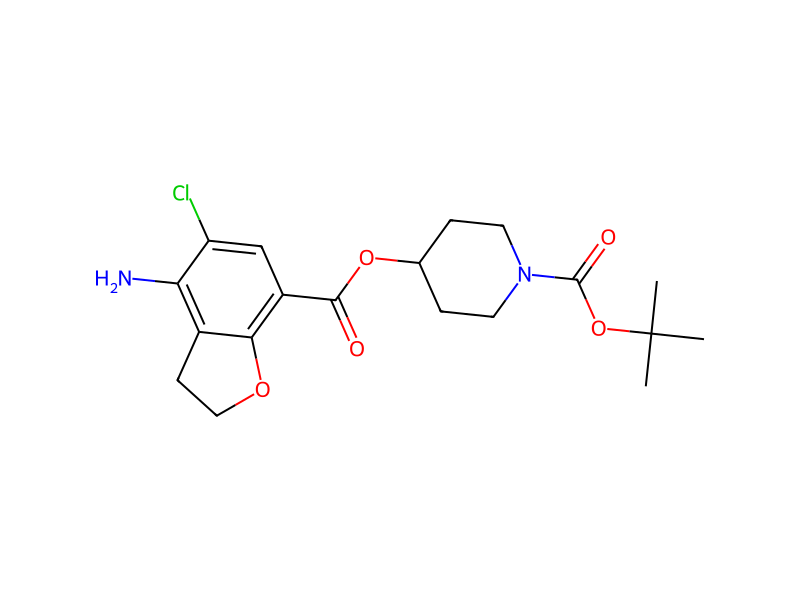
[NH2:1][C:2]1[C:7]2[CH2:8][CH2:9][O:10][C:6]=2[C:5]([C:11]([O:13][CH:14]2[CH2:19][CH2:18][N:17](C(OC(C)(C)C)=O)[CH2:16][CH2:15]2)=[O:12])=[CH:4][C:3]=1[Cl:27].[NH4+].[OH-]>O1CCCC1.Cl>[NH2:1][C:2]1[C:7]2[CH2:8][CH2:9][O:10][C:6]=2[C:5]([C:11]([O:13][CH:14]2[CH2:19][CH2:18][NH:17][CH2:16][CH2:15]2)=[O:12])=[CH:4][C:3]=1[Cl:27]A mixture of intermediate (8) (7 g) in tetrahydrofuran (20 ml) and hydrochloric acid (20 ml) was stirred and refluxed for 2 hours. The reaction mixture was cooled and alkalized with NH4OH. The organic layer was removed by decantation and the solvent was evaporated. The residue was purified by column chromatography over silica gel (eluent: CH2Cl2 /(CH3OH/NH3) 92/8). The pure fractions were collected and the solvent was evaporated. The residue (5.5 g) was repurified by high-performance liquid chromatography (column: 200 g Kromasil; 10 μm; 100 Å; eluent: (0.5% NH4OAc in water)/methanol 70/30). The pure fractions were collected and extracted with NH3 /CH2Cl2. The extract was evaporated. The residue was crystallized from acetonitrile. The precipitate was filtered off and dried (vacuum; 70° C.), yielding 2.60 g of 4-piperidinyl 4-amino-5-chloro-2,3-dihydro-7-benzofurancarboxylate (54%) (intermediate 9).