N-Hydroxyphthalimide → 2-[(Cyclohex-2-en-1-yl)oxy]-1H-isoindole-1,3(2H)-dione
Reaction equation
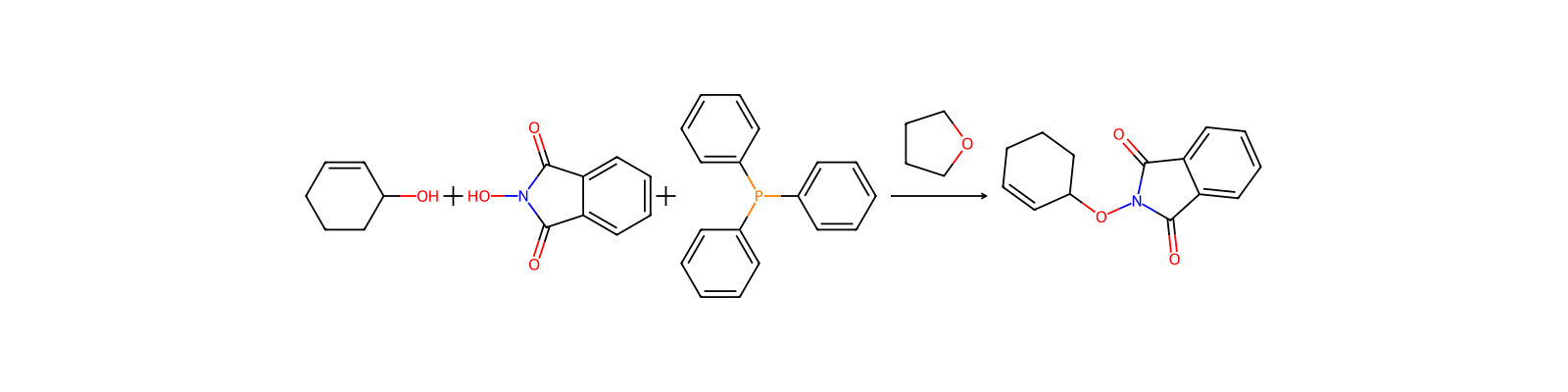
[OH:1][CH:2]1[CH2:7][CH2:6][CH2:5][CH:4]=[CH:3]1.O[N:9]1[C:13](=[O:14])[C:12]2=[CH:15][CH:16]=[CH:17][CH:18]=[C:11]2[C:10]1=[O:19].C1(P(C2C=CC=CC=2)C2C=CC=CC=2)C=CC=CC=1>O1CCCC1>[CH:2]1([O:1][N:9]2[C:10](=[O:19])[C:11]3=[CH:18][CH:17]=[CH:16][CH:15]=[C:12]3[C:13]2=[O:14])[CH2:7][CH2:6][CH2:5][CH:4]=[CH:3]1Participants
5
Reactant 3



Product 1

Reagents, catalysts & solvents 1

Procedure
A mixture of 3-hydroxycyclohexene (4.0 g), N-hydroxyphthalimide (6.7 g) and triphenyl phosphine (9.2 g) in tetrahydrofuran (200 ml) was stirred at room temperature. After the addition of diethyl azoformate (7.9 g), the resulting mixture was stirred for 20 hours at room temperature. The reaction mixture was evaporated and the residue was subjected to column chromatography on silica gel (80 g), using chloroform as an eluent. The fractions containing the objected compounds were combined and evaporated to give N-(2-cyclohexen-1-yl)oxyphthalimide (6.5 g).
Workup
- stirringthe resulting mixture was stirred for 20 hours at room temperature
- customThe reaction mixture was evaporated
- additionThe fractions containing the objected compounds
- customevaporated
Sources & evidence
- ORD record
- ord-df717b1acbdb4e8a8f9e2f7cf469ac7f
- Source dataset
- uspto-grants-1985_07
- Patent number
- US04529802
Reaction notes
Loading…