Hydrochloric Acid → Indoline
Reaction equation

[Sn].Cl.CO[C:5]1[CH:6]=[C:7]2[C:11](=[CH:12][C:13]=1OC)[NH:10][C:9](C)=[C:8]2CCN1CCN(C2C=CC=CC=2)CC1.COC1C=C2C(=CC=1OC)N[C@@H](C)[C@H]2CCN1CCN(C2C=CC=CC=2)CC1.N1C2C(=CC=CC=2)C=C1.B#B.C[O-].[Na+]>[Cr]([O-])([O-])=O.[Cu+2]>[NH:10]1[C:11]2[C:7](=[CH:6][CH:5]=[CH:13][CH:12]=2)[CH2:8][CH2:9]1Participants
Reactant 7






Product 1
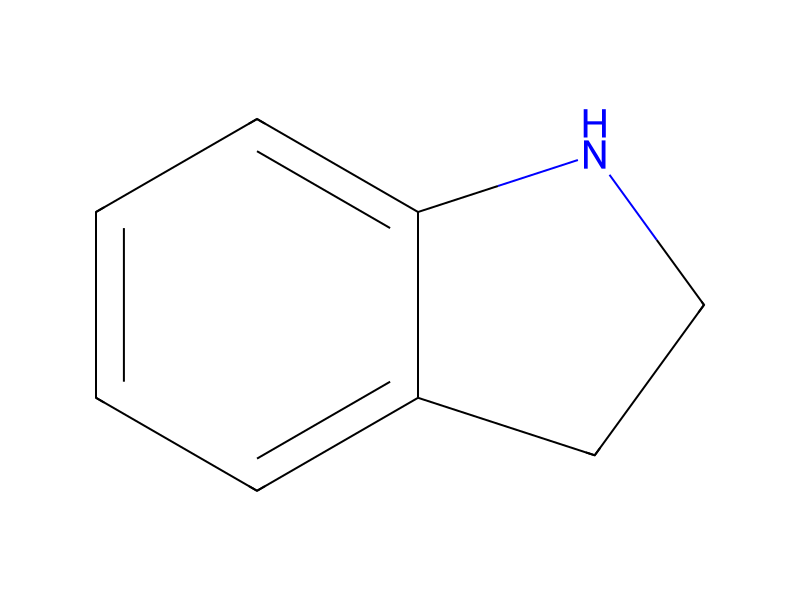
Reagents, catalysts & solvents 1

Procedure
The tin and hydrochloric acid reduction of 5,6-dimethoxy-2-methyl-3-[2-(4-phenyl-1-piperazinyl)ethyl]indole to cis-5,6-dimethoxy-2-methyl-3-[2-(4-phenyl-1-piperazinyl)ethyl]indoline suffers from low productivity in that it has not been possible to isolate more than 60-65% of crude product. Furthermore, this crude material is contaminated with 6-7% of trans-isomer and 1-2% of starting material. Purification by two recrystallizations is required to provide pure cis-isomer in 9% overall yield. Alternate methods of reducing the starting indole such as electrochemical-lead electrodes, diborane and sodium methoxide, and catalytic reduction with copper chromite catalyst provide from 50/50 cis/trans mixtures to 70/30 cis/trans mixtures of indoline. The stereoselectivity of the novel process of the present invention is thus completely unexpected particularly in view of the fact that ionic hydrogenation usually results in the formation of the thermodynamically more stable trans-isomer.
Workup
- customto isolate more than 60-65% of crude product
- customPurification
- customby two recrystallizations
- customto provide pure cis-isomer in 9% overall yield
Sources & evidence
- ORD record
- ord-b783020724da472eb10284fc0955e4c4
- Source dataset
- uspto-grants-1978_05
- Patent number
- US04089853
Reaction notes
Loading…