Reaction equation

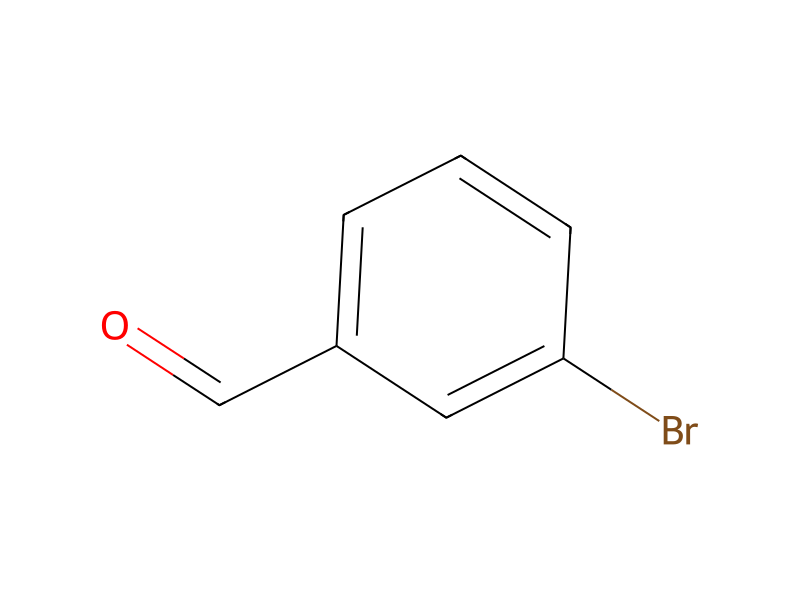
Br[C:2]1[CH:3]=[C:4]([CH:7]=[CH:8][CH:9]=1)[CH:5]=[O:6].[CH:10]#[C:11][CH2:12][CH2:13][CH2:14][CH2:15][CH2:16][CH2:17][CH2:18][CH2:19][CH3:20]>C(N(CC)CC)C.C(OCC)(=O)C.Cl[Pd](Cl)([P](C1C=CC=CC=1)(C1C=CC=CC=1)C1C=CC=CC=1)[P](C1C=CC=CC=1)(C1C=CC=CC=1)C1C=CC=CC=1.[Cu]I>[C:10]([C:2]1[CH:3]=[C:4]([CH:7]=[CH:8][CH:9]=1)[CH:5]=[O:6])#[C:11][CH2:12][CH2:13][CH2:14][CH2:15][CH2:16][CH2:17][CH2:18][CH2:19][CH3:20]Participants
7
Reactant 2

Product 1

Reagents, catalysts & solvents 4




Conditions
- Temperature
- 55 °C
Procedure
To a solution of 3-bromobenzaldehyde (30.3 g) and 1-undecyne (29.5 g) in triethylamine (120 ml) was added bis(triphenylphosphine)palladium(II) chloride (1.9 g) followed by copper(I) iodide (0.25 g). The mixture was stirred in the dark at 55° C. for 6 hrs, under nitrogen. After cooling to room temperature, the reaction mixture was diluted with ethyl acetate and filtered. The filtrate was washed with water and saturated sodium chloride solution, dried over anhydrous magnesium sulfate, filtered, and the filtrate was concentrated to yield 45.8 g of 3-(1-undecynyl)benzaldehyde, as an oil.
Workup
- temperatureAfter cooling to room temperature
- filtrationfiltered
- washThe filtrate was washed with water and saturated sodium chloride solution
- dry with materialdried over anhydrous magnesium sulfate
- filtrationfiltered
- concentrationthe filtrate was concentrated
Sources & evidence
- ORD record
- ord-40aee210694347b68fd5090038baba40
- Source dataset
- uspto-grants-1996_01
- Patent number
- US05488061
Linked notes
Loading…