Diisopropylethylamine → 8-Hydroxy-N-[(4-nitrophenyl)methyl]-7-quinolinecarboxamide
Reaction equation

[OH:1][C:2]1[C:3]([C:12]([OH:14])=O)=[CH:4][CH:5]=[C:6]2[C:11]=1[N:10]=[CH:9][CH:8]=[CH:7]2.Cl.[N+:16]([C:19]1[CH:26]=[CH:25][C:22]([CH2:23][NH2:24])=[CH:21][CH:20]=1)([O-:18])=[O:17].C(N(C(C)C)CC)(C)C.Cl.CN(C)CCCN=C=NCC.O.ON1C2C=CC=CC=2N=N1>O.CN(C=O)C>[OH:1][C:2]1[C:3]([C:12]([NH:24][CH2:23][C:22]2[CH:21]=[CH:20][C:19]([N+:16]([O-:18])=[O:17])=[CH:26][CH:25]=2)=[O:14])=[CH:4][CH:5]=[C:6]2[C:11]=1[N:10]=[CH:9][CH:8]=[CH:7]2Participants
8
Reactant 5



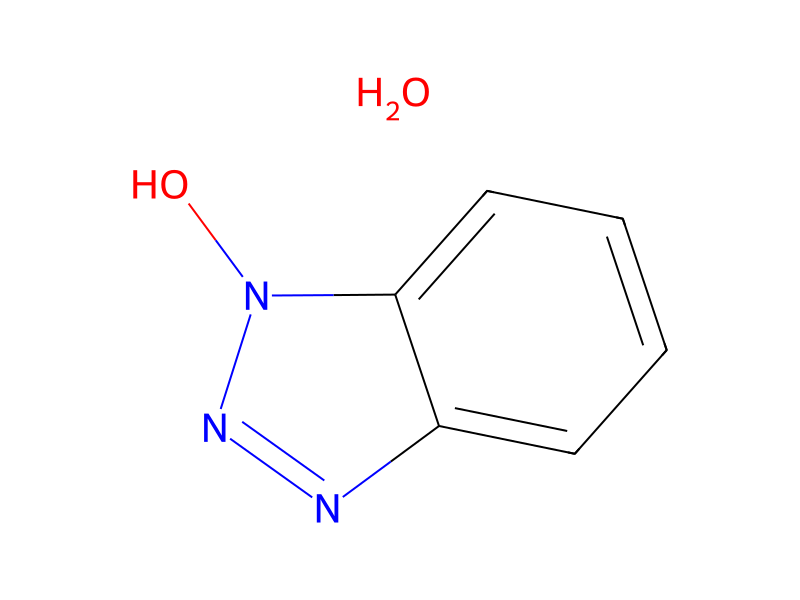

Product 1

Reagents, catalysts & solvents 2


Procedure
8-Hydroxyquinoline-7-carboxylic acid (0.51 g) of Preparation 1 is added to 20 mL DMF. 4-Nitrobenzylamine hydrochloride (0.53 g) followed by diisopropylethylamine (0.49 mL) is then added. After 10 minutes, all solids go into solution. 1-(3-Dimethylaminopropyl)-3-ethylcarbodiimide hydrochloride (0.54 g) and 1-hydroxybenzotriazole monohydrate (0.38 g) are added and the reaction stirred at room temperature overnight. The reaction is poured into 75 mL H2O. The resulting solid is filtered and dried to give the title product (0.53 g).
Workup
- additionis then added
- filtrationThe resulting solid is filtered
- customdried
Sources & evidence
- ORD record
- ord-6402cdd2e1a54551a6a734db8f90dc8d
- Source dataset
- uspto-grants-2001_10
- Patent number
- US06310211B1
Reaction notes
Loading…