HomeMCPWorkbenchSkills
HomeWorkbenchNotificationsMe
llms.txt · MCP GuidePrivacy Policy · Terms of Service · Supportv1.8.3
  1. Home
  2. /Reaction

Pyrazole → 2-Chloro-4-methylsulfonyl-3-(pyrazol-1-yl)benzoic Acid

HRID 399937
Print

Reaction equation

HRID 399937 reaction equation
[NH:1]1[CH:5]=[CH:4][CH:3]=[N:2]1.[H-].[Na+].[Cl:8][C:9]1[C:17](F)=[C:16]([S:19]([CH3:22])(=[O:21])=[O:20])[CH:15]=[CH:14][C:10]=1[C:11]([OH:13])=[O:12]>CN(C)C=O>[Cl:8][C:9]1[C:17]([N:1]2[CH:5]=[CH:4][CH:3]=[N:2]2)=[C:16]([S:19]([CH3:22])(=[O:21])=[O:20])[CH:15]=[CH:14][C:10]=1[C:11]([OH:13])=[O:12]
ParticipantsConditionsProcedureWorkupSources & evidenceReaction notes

Participants

5

Reactant 3

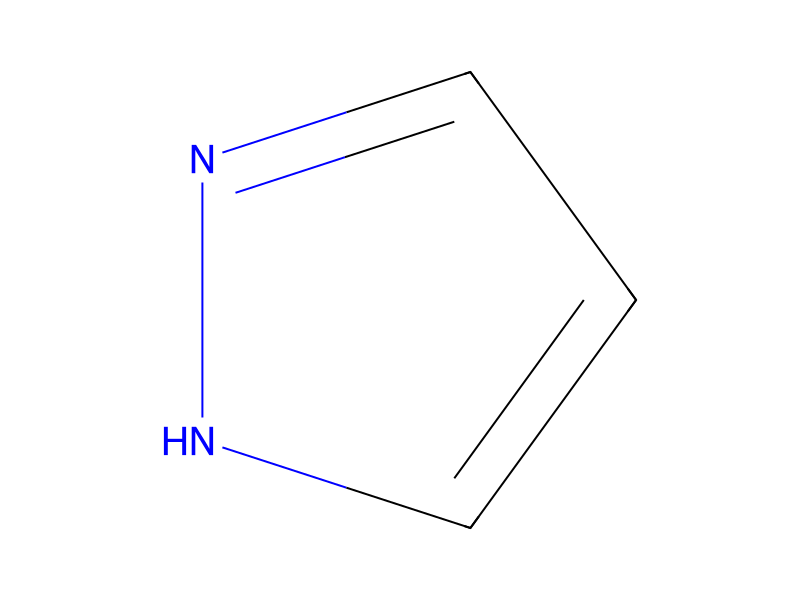
HCID 1048PyrazoleHCID 24758Sodium hydrideHCID 154517592-Chloro-3-fluoro-4-methylsulfonylbenzoic acid

Product 1

HCID 154517672-Chloro-4-methylsulfonyl-3-(pyrazol-1-yl)benzoic Acid

Reagents, catalysts & solvents 1

HCID 6228DimethylformamideSolvent

Conditions

Temperature
50 °C

Procedure

Pyrazole (210 mg, 3.09 mmol) was added to 190 mg (4.75 mmol) of 60 percent oil dispersed sodium hydride suspended in 7 mL of dry dimethylformamide. After the gas evolution had subsided, 500 mg (1.98 mmol) of 2-chloro-3-fluoro-4-methylsulfonylbenzoic acid was added and the mixture was stirred at 50° C. overnight. The mixture was then concentrated by evaporation under reduced pressure and the residue was partitioned between ethyl acetate and 1N aqueous hydrochloric acid. The aqueous phase was extracted with ethyl acetate. The organic phases were combined and extracted with dilute aqueous sodium bicarbonate solution. The aqueous extract was acidified with 1N aqueous hydrochloric acid and extracted with dichloromethane. The organic extract was concentrated by evaporation under reduced pressure. The crystalline residue obtained was purified by rinsing with ethyl acetate to obtain 540 mg (91 percent of theory) of the title compound as a white powder.

Workup

  1. concentrationThe mixture was then concentrated by evaporation under reduced pressure
  2. customthe residue was partitioned between ethyl acetate and 1N aqueous hydrochloric acid
  3. extractionThe aqueous phase was extracted with ethyl acetate
  4. extractionextracted with dilute aqueous sodium bicarbonate solution
  5. extractionThe aqueous extract
  6. extractionextracted with dichloromethane
  7. extractionThe organic extract
  8. concentrationwas concentrated by evaporation under reduced pressure
  9. customThe crystalline residue obtained
  10. customwas purified
  11. washby rinsing with ethyl acetate

Sources & evidence

ORD record
ord-18a733613b2f4c5b8318fa7bdbf90ed9
Source dataset
uspto-grants-1998_10
DOI
10.6084/m9.figshare.5104873.v1
Patent number
US05824802

Reaction notes

On this pageParticipantsConditionsProcedureWorkupSources & evidenceReaction notes

