HomeMCPSkillsWorkbenchOpenChem
HomeWorkbenchNotificationsMe
llms.txt · skill.md · MCP GuidePrivacy Policy · Terms of Service · Supportv1.8.5
  1. Home
  2. /Reaction

Potassium Phosphate, Tribasic → Methyl 3-(5,5-dimethyl-1-cyclopenten-1-yl)-5-fluoro-4-(((4-(methyloxy)phenyl)methyl)oxy)benzoate

HRID 404340
Print

Reaction equation

Br[C:2]1[CH:3]=[C:4]([CH:9]=[C:10]([F:22])[C:11]=1[O:12][CH2:13][C:14]1[CH:19]=[CH:18][C:17]([O:20][CH3:21])=[CH:16][CH:15]=1)[C:5]([O:7][CH3:8])=[O:6].COC1C=CC=C(OC)[C:30]=1[C:31]1[CH:32]=[CH:33][CH:34]=[CH:35][C:36]=1P(C1CCCCC1)C1CCCCC1.[O-]P([O-])([O-])=O.[K+].[K+].[K+].CC1(C)C(B2OC(C)(C)C(C)(C)O2)=CCC1>CN(C=O)C.O.C([O-])(=O)C.[Pd+2].C([O-])(=O)C>[CH3:32][C:31]1([CH3:30])[C:36]([C:2]2[CH:3]=[C:4]([CH:9]=[C:10]([F:22])[C:11]=2[O:12][CH2:13][C:14]2[CH:19]=[CH:18][C:17]([O:20][CH3:21])=[CH:16][CH:15]=2)[C:5]([O:7][CH3:8])=[O:6])=[CH:35][CH2:34][CH2:33]1

ParticipantsConditionsProcedureWorkupSources & evidenceReaction notes

Participants

8

Reactant 4

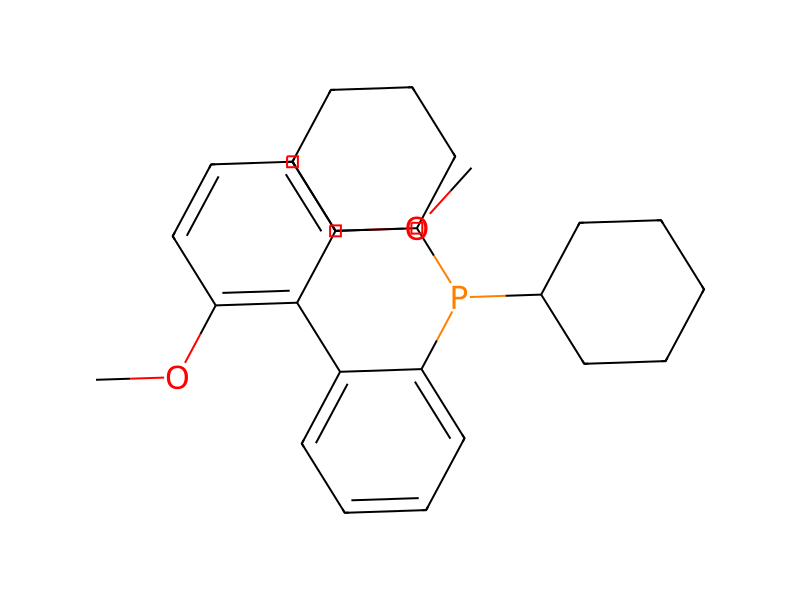
HCID 62657Potassium Phosphate, TribasicHCID 112698722-Dicyclohexylphosphino-2',6'-dimethoxybiphenylHCID 574675872-(5,5-Dimethylcyclopent-1-enyl)-4,4,5,5-tetramethyl-1,3,2-dioxaborolaneHCID 57467636Methyl 3-bromo-5-fluoro-4-((4-methoxybenzyl)oxy)benzoate

Product 1

HCID 57706615
Methyl 3-(5,5-dimethyl-1-cyclopenten-1-yl)-5-fluoro-4-(((4-(methyloxy)phenyl)methyl)oxy)benzoate
Yield 331.1%

Reagents, catalysts & solvents 3

HCID 167845palladium(II) acetateCatalystHCID 962WaterSolvent2×HCID 6228DimethylformamideSolvent

Conditions

Temperature
75 °C

Procedure

A stirred mixture of T10.3 (1.63 g, 4.420 mmol), ground S-Phos (0.36 g, 0.88 mmol), palladium acetate (0.10 g, 0.45 mmol), and potassium phosphate tribasic (2.35 g, 11.06 mmol) in DMF (13 mL) and water (0.4 mL) was purged three times with argon and placed under vacuum three times. 2-(5,5-Dimethylcyclopent-1-enyl)-4,4,5,5-tetramethyl-1,3,2-dioxaborolane (T2.2) (1.47 g, 6.63 mmol) was added to the mixture via syringe, and the resulting mixture was heated to 75° C. After 18 hours (black solution), the reaction was cooled to room temperature, diluted with water, and extracted three times with EtOAc. The combined organic layers were washed twice with brine. After drying over anhydrous sodium sulfate and filtration, the organic solvent was removed under reduced pressure. The residue was purified on a 40 g column of silica gel (0-10% EtOAc in hexanes) to afford T10.4 as a white solid (1.12 g, 66% yield). 1H NMR (400 MHz, CDCl3) δ ppm 7.69 (1H, dd, J=11.7, 2.3 Hz), 7.57 (1H, dd, J=2.0, 1.2 Hz), 7.31 (2H, m), 6.88 (2H, m), 5.56 (1H, t, J=2.5 Hz), 5.01 (2H, s), 3.91 (3H, s), 3.82 (3H, s), 2.42 (2H, td, J=7.0, 2.7 Hz), 1.86 (2H, t, J=7.2 Hz), 1.06 (6H, s).

Workup

  1. customwas purged three times with argon
  2. temperaturethe reaction was cooled to room temperature
  3. extractionextracted three times with EtOAc
  4. washThe combined organic layers were washed twice with brine
  5. dry with materialAfter drying over anhydrous sodium sulfate and filtration
  6. customthe organic solvent was removed under reduced pressure
  7. customThe residue was purified on a 40 g column of silica gel (0-10% EtOAc in hexanes)

Sources & evidence

ORD record
ord-87d70399898c4c3a99dfc4648fe42296
Source dataset
uspto-grants-2014_06
DOI
10.6084/m9.figshare.5104873.v1
Patent number
US08748462B2

Reaction notes

On this pageParticipantsConditionsProcedureWorkupSources & evidenceReaction notes


