Reaction equation

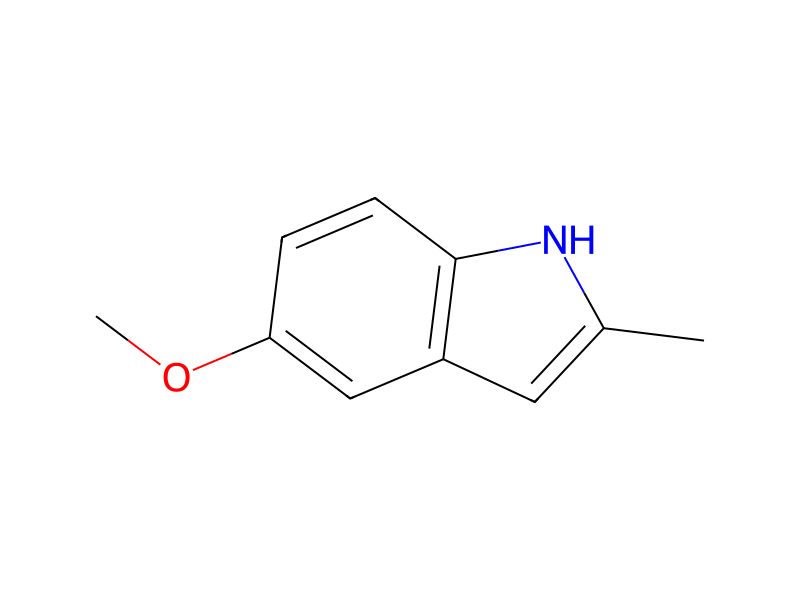
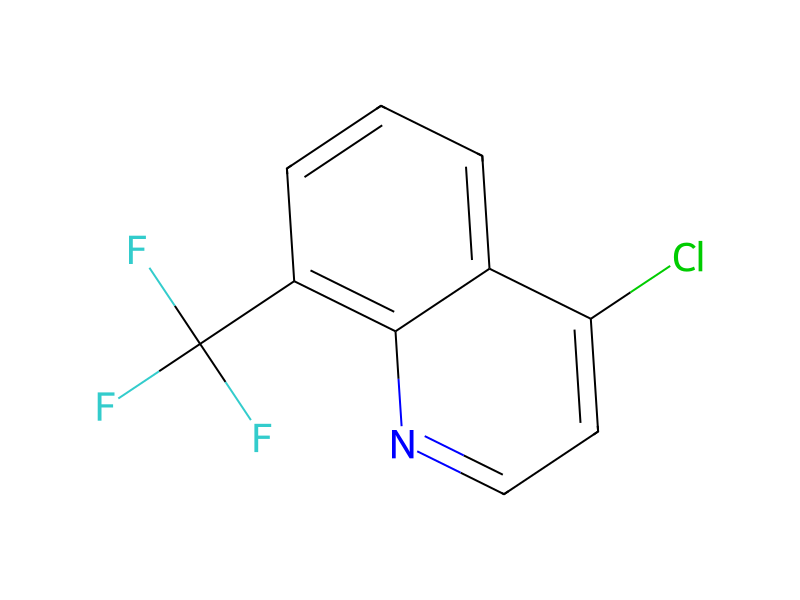
[CH3:1][O:2][C:3]1[CH:4]=[C:5]2[C:9](=[CH:10][CH:11]=1)[NH:8][C:7]([CH3:12])=[CH:6]2.Cl[C:14]1[C:23]2[C:18](=[C:19]([C:24](F)(F)F)[CH:20]=[CH:21][CH:22]=2)[N:17]=[CH:16][CH:15]=1.C(=O)(O)[O-].[Na+]>CN1C(=O)CCC1.Cl.O1CCOCC1>[CH3:1][O:2][C:3]1[CH:4]=[C:5]2[C:9](=[CH:10][CH:11]=1)[NH:8][C:7]([CH3:12])=[C:6]2[C:14]1[C:23]2[C:18](=[C:19]([CH3:24])[CH:20]=[CH:21][CH:22]=2)[N:17]=[CH:16][CH:15]=1Participants
7
Reactant 3

Product 1

Reagents, catalysts & solvents 3



Conditions
- Temperature
- 140 °C
Procedure
A mixture of 5-methoxy-2-methylindole (346 mg) and 4-chloro-8-trifluoromethylquinoline (380 mg) in NMP (1 ml) and 4M HCl in dioxane (0.1 ml) was heated at 140° C. for 50 min. Aqueous sodium bicarbonate was added and the mixture was extracted with ethyl acetate. The organic extracts were dried (MgSO4), evaporated and purified by chromatography (silica, petrol-acetone as eluent) to give the sub-title compound (465 mg).
Workup
- extractionthe mixture was extracted with ethyl acetate
- dry with materialThe organic extracts were dried (MgSO4)
- customevaporated
- custompurified by chromatography (silica, petrol-acetone as eluent)
Sources & evidence
- ORD record
- ord-1212322d85cc4dc092eb8ba137401bee
- Source dataset
- uspto-grants-2012_01
- Patent number
- US08093278B2
Linked notes
Loading…