Reaction equation
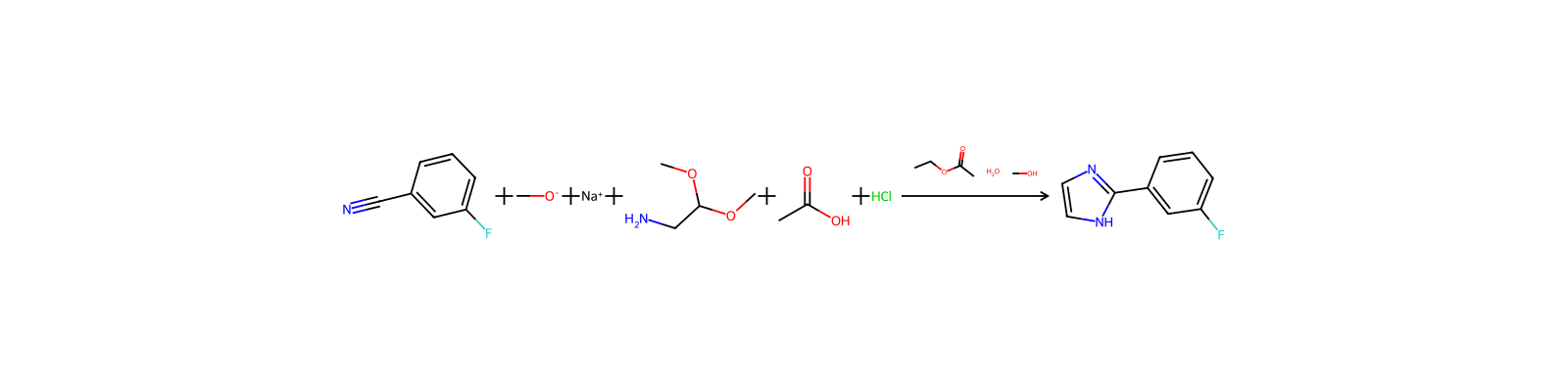
[F:1][C:2]1[CH:3]=[C:4]([CH:7]=[CH:8][CH:9]=1)[C:5]#[N:6].C[O-].[Na+].CO[CH:15](OC)[CH2:16][NH2:17].C(O)(=O)C.Cl>C(OCC)(=O)C.O.CO>[F:1][C:2]1[CH:3]=[C:4]([C:5]2[NH:17][CH:16]=[CH:15][N:6]=2)[CH:7]=[CH:8][CH:9]=1Participants
Reactant 5





Product 1

Reagents, catalysts & solvents 3



Procedure
In a flask containing 3-flourobenzonitrile (Matrix Scientific, 3.0 g, 25 mmol) was added methanol (30 mL) and sodium methoxide (Aldrich, 25% by wt. in methanol, 2.83 mL, 12.4 mmol). The reaction mixture was stirred for 1.5 hours and aminoacetaldehyde dimethyl acetal (Alfa Aesar, 2.60 g, 24.8 mmol) and acetic acid (2.83 mL, 49.5 mmol) were subsequently added and the solution was heated at reflux for one hour. After cooling to room temperature, methanol (25 mL) and 6 N HCl (8 mL) was added and the solution was heated at reflux for 16 hours. After cooling the solution to room temperature the residue was taken up in a 1:1 mixture (v/v) of water and ethyl acetate (50 mL). The aqueous layer was separated and the pH of this solution was adjusted to pH 9 with 2 N NaOH, upon which a white precipitate formed in solution. The solid was collected by filtration and dried under high vacuum to provide 2-(3-fluorophenyl)-1H-imidazole as an off-white solid (1.67 g, 41% yield, MS (ESI+) m/z 163.1 (M+1).
Workup
- temperaturethe solution was heated
- temperatureat reflux for one hour
- temperaturethe solution was heated
- temperatureat reflux for 16 hours
- temperatureAfter cooling the solution to room temperature the residue
- customThe aqueous layer was separated
- customformed in solution
- filtrationThe solid was collected by filtration
- customdried under high vacuum
Sources & evidence
- ORD record
- ord-d07c9840b9234973930b2cb4f8b36d18
- Source dataset
- uspto-grants-2013_09
- Patent number
- US08536185B2
Linked notes
Loading…