HomeMCPWorkbenchSkills
HomeWorkbenchNotificationsMe
llms.txt · MCP GuidePrivacy Policy · Terms of Service · Supportv1.8.0
  1. Home
  2. /Reaction

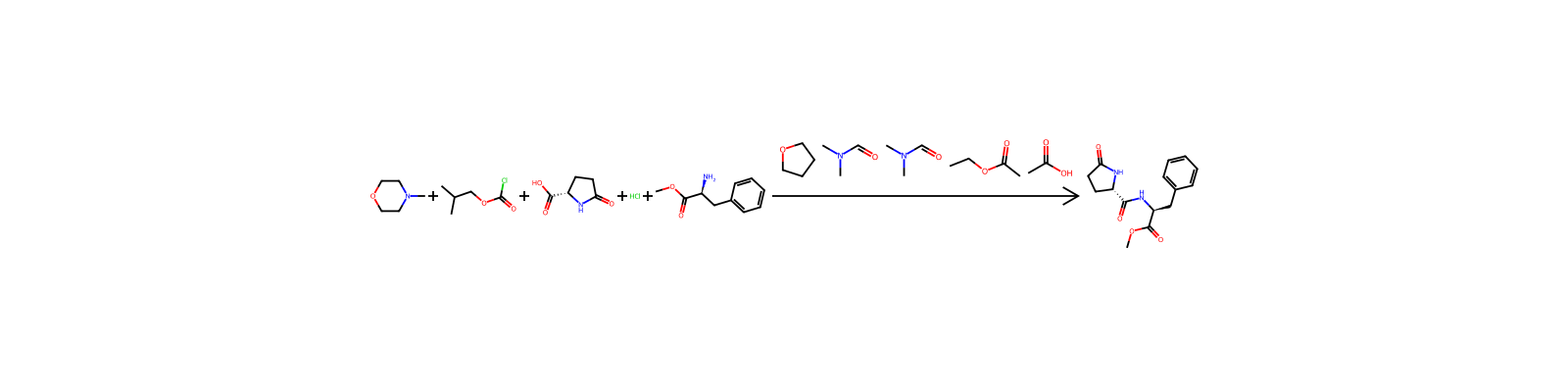
L-Pyroglutamic Acid → L-Pyroglutamyl-L-phenylalanine Methyl Ester

HRID 4497
Notes
Print preview

Reaction equation

HRID 4497 reaction equation
CN1CCOCC1.ClC(OCC(C)C)=O.[NH:16]1[C:20](=[O:21])[CH2:19][CH2:18][C@H:17]1[C:22]([OH:24])=O.Cl.[CH3:26][O:27][C:28](=[O:38])[C@H:29]([CH2:31][C:32]1[CH:37]=[CH:36][CH:35]=[CH:34][CH:33]=1)[NH2:30]>C1COCC1.CN(C=O)C.CN(C=O)C.CCOC(C)=O.CC(O)=O>[CH3:26][O:27][C:28](=[O:38])[C@H:29]([CH2:31][C:32]1[CH:37]=[CH:36][CH:35]=[CH:34][CH:33]=1)[NH:30][C:22](=[O:24])[C@@H:17]1[CH2:18][CH2:19][C:20](=[O:21])[NH:16]1
ParticipantsProcedureWorkupSources & evidenceReaction notes

Participants

8

Reactant 4

HCID 7405L-Pyroglutamic AcidHCID 79724-Methylmorpholine2×HCID 62365Isobutyl chloroformateHCID 75736Methyl L-phenylalaninate hydrochloride

Product 1

HCID 12378871L-Pyroglutamyl-L-phenylalanine Methyl Ester

Reagents, catalysts & solvents 3

HCID 6228
Dimethylformamide
Solvent
HCID 21974620tetrahydrofuran N,N-dimethylformamideSolvent
HCID 22609514Ethyl acetate acetateSolvent

Procedure

N-Methylmorpholine (2.02 g, 0.020 mol) and isobutyl chloroformate (2.73 g, 0.020 mol) were added to a solution of L-pyroglutamic acid (2.58 g, 0.020 mol) in 100 ml of THF/DMF (6:1) at -15° C. After a 2 minute coupling period, a mixture of L-phenylalanine methyl ester hydrochloride (4.31 g, 0.020 mol) (suspension) and N-methyl morpholine (2.02 g, 0.020 mol) in 50 ml of DMF was added to the reaction mixture. The reaction was allowed to proceed at this temperature for 30 minutes and then at room temperature for 1 additional hour. The reaction mixture was then filtered to remove fines and the filtrate was evaporated in vacuo to incipient dryness. The resulting yellow liquid was dissolved in 100 ml of ethyl acetate, and the ethyl acetate solution was washed with 5% citric acid saturated with sodium chloride (50 ml) and 5% sodium bicarbonate saturated with NaCl (50 ml). The separated organic layer was dried over anhydrous sodium sulfate and evaporated in vacuo to yield quantitative amounts of a pale yellow liquid which was used directly for the following step. TLC: Rf =0.22 in EtOAc/AcOH (100:1), detected by UV quenching; IR (neat, cm-1) 3300 (NH), 3020-3060 (C6H5), 2860-2960 (alkyl), 1650-1750 (C=O); NMR (Silanor C, δ from TMS) 7.25 (fused s, C6H5 --), 5.5-5.7 and 6.6-6.8 (broad, NH's), 4.6-5.1 (g, --NH--CH--C=O), 3.0-3.2 (q, --CH2 --C6H5), 1.6-2.5 (m, cycl. O=C--CH2 --CH2).
Workup

  1. additionwas added to the reaction mixture
  2. waitto proceed at this temperature for 30 minutes
  3. customat room temperature
  4. filtrationThe reaction mixture was then filtered
  5. customto remove fines
  6. customthe filtrate was evaporated in vacuo
  7. dissolutionThe resulting yellow liquid was dissolved in 100 ml of ethyl acetate
  8. washthe ethyl acetate solution was washed with 5% citric acid saturated with sodium chloride (50 ml) and 5% sodium bicarbonate saturated with NaCl (50 ml)
  9. dry with materialThe separated organic layer was dried over anhydrous sodium sulfate
  10. customevaporated in vacuo
  11. customto yield quantitative amounts of a pale yellow liquid which
  12. customquenching

Sources & evidence

ORD record
ord-c4b5968c16f543fc8c35e4b753328296
Source dataset
uspto-grants-1988_02
DOI
10.6084/m9.figshare.5104873.v1
Patent number
US04726941

Reaction notes

Loading…

On this pageParticipantsProcedureWorkupSources & evidenceReaction notes

