Reaction equation

Cl[C:2]([O:4][CH2:5][C:6]1[CH:11]=[CH:10][CH:9]=[CH:8][CH:7]=1)=[O:3].[NH2:12][C:13]1[CH:18]=[CH:17][C:16]([N:19]2[CH2:23][CH2:22][CH2:21][C:20]2=[O:24])=[CH:15][CH:14]=1.CN(C)C1C=CC=CC=1.C(OCC)(=O)C>O1CCCC1>[O:24]=[C:20]1[CH2:21][CH2:22][CH2:23][N:19]1[C:16]1[CH:17]=[CH:18][C:13]([NH:12][C:2](=[O:3])[O:4][CH2:5][C:6]2[CH:11]=[CH:10][CH:9]=[CH:8][CH:7]=2)=[CH:14][CH:15]=1Participants
6


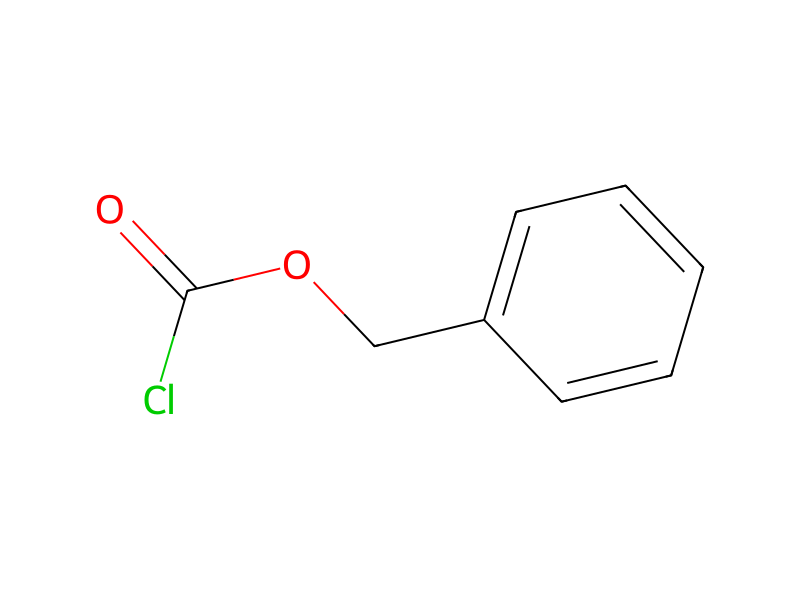



Conditions
- Temperature
- -20 °C
Procedure
4.27 g (25.03 mmol) of benzyl chloroformate are slowly added to 4 g (22.7 mmol) of 1-(4-aminophenyl)pyrrolidin-2-one and 3.6 ml (28.4 mmol) of N,N-dimethylaniline in 107 ml of tetrahydrofuran at −20° C. The mixture is stirred at −20° C. for 30 minutes and then allowed to reach room temperature. 0.5 l of ethyl acetate is added, and the organic phase is washed with 0.5 l of saturated NaCl solution. The removed organic phase is dried with MgSO4, and the solvent is evaporated in vacuo. The residue is triturated with diethyl ether and filtered off with suction. 5.2 g (73.8% of theory) of benzyl 4-(2-oxo-1-pyrrolidinyl)phenylcarbamate are obtained as pale beige crystals with a melting point of 174° C.
Workup
- customto reach room temperature
- washthe organic phase is washed with 0.5 l of saturated NaCl solution
- dry with materialThe removed organic phase is dried with MgSO4
- customthe solvent is evaporated in vacuo
- customThe residue is triturated with diethyl ether
- filtrationfiltered off with suction
Sources & evidence
- ORD record
- ord-b678ad7d47524d1ab57465d1e6ea7d61
- Source dataset
- uspto-grants-2010_08
- Patent number
- US07767702B2
Linked notes
Loading…