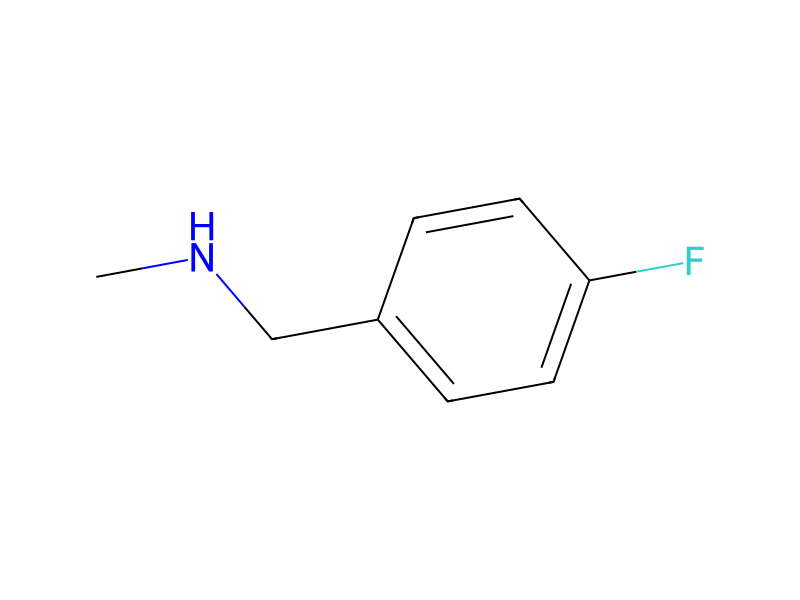
4,6-dibromobenzo[c][1,2,5]oxadiazole (0.3688 g, 1.33 mmol), 4-fluoro-N-methylbenzylamine (0.18 mL, 1.39 mmol), NMP (3 mL) and DIPEA (0.26 mL, 1.5 mmol) were sealed in a tube and heated to 100° C. overnight. Upon cooling to room temperature, the mixture was diluted with water and EtOAc. The layers were separated and the aqueous layer was then back-extracted. The combined organic extracts were then washed with H2O, 1 N HCl (aq), saturated NaHCO3 (aq), H2O (3×), brine and then dried (Na2SO4), filtered and concentrated to give 6-bromo-N-(4-fluorobenzyl)-N-methylbenzo[c][1,2,5]oxadiazol-4-amine. The crude aniline and 3-formylbenzeneboronic acid (0.2593 g, 1.73 mmol) were sealed in a tube. The tube was evacuated and purged with argon (3 cycles). 2M Na2CO3 (2.0 mL, aq solution) was added along with DME (3.0 mL). The solution was degassed for 10 minutes and then Pd(PPh3)4 (0.0768 g, 0.066 mmol) was added all at once. The tube was re-sealed and heated to 100° C. overnight. After cooling to room temperature, the mixture was diluted with water and EtOAc. The layers were separated and the aqueous layer was then back-extracted. The combined organic extracts were then washed with H2O (3×), brine and then dried (Na2SO4), filtered and concentrated. This crude material was then dissolved in THF (4.0 mL) and cooled in an ice bath. To this solution was added CF3TMS (0.39 mL, 2.66 mmol) and then TBAF (0.1 mL, 1.0 M solution in THF). After 5 minutes, the ice bath was removed and the mixture was stirred for an additional 2 hours. The solution was then re-cooled to 0° C. and TBAF (4.7 mL, 4.7 mmol) was added, the mixture was allowed to warm to room temperature overnight. The mixture was diluted with water and EtOAc. The layers were separated and the aqueous layer was then back-extracted. The combined organic extracts were then washed with H2O (3×), brine and then dried (Na2SO4), filtered and concentrated. The crude material was purified via chromatography (15% EtOAc/hexane) to afford 0.2675 g (47% yield, 4 steps) of TRV-1390. 1H NMR (500 MHz, CDCl3) δ=7.70 (s, 1H), 7.64 (dt, J=7.0, 2.0 Hz, 1H), 7.55-7.50 (m, 2H), 7.27-7.24 (m, 3H), 7.04-7.00 (m, 2H), 6.34 (s, 1H), 5.12-5.10 (m, 3H), 3.19 (s, 3H), 2.71 (s, 1H).