HomeMCPWorkbenchSkills
HomeWorkbenchNotificationsMe
llms.txt · MCP GuidePrivacy Policy · Terms of Service · Supportv1.8.3
  1. Home
  2. /Reaction

Trifluoroacetic acid → 4-Chloro-6-(4-isopropoxyphenyl)-2,2'-bipyridine

HRID 523150
Print

Reaction equation

HRID 523150 reaction equation
Cl[C:2]1[CH:7]=[C:6]([Cl:8])[CH:5]=[C:4]([C:9]2[CH:14]=[CH:13][C:12]([O:15][CH:16]([CH3:18])[CH3:17])=[CH:11][CH:10]=2)[N:3]=1.C([Sn](CCCC)(CCCC)[C:24]1[CH:29]=[CH:28][CH:27]=[CH:26][N:25]=1)CCC.[F-].[Cs+].C(O)(C(F)(F)F)=O>[Cu]I.C1C=CC([P]([Pd]([P](C2C=CC=CC=2)(C2C=CC=CC=2)C2C=CC=CC=2)([P](C2C=CC=CC=2)(C2C=CC=CC=2)C2C=CC=CC=2)[P](C2C=CC=CC=2)(C2C=CC=CC=2)C2C=CC=CC=2)(C2C=CC=CC=2)C2C=CC=CC=2)=CC=1.CO.O.CN(C=O)C>[Cl:8][C:6]1[CH:5]=[C:4]([C:9]2[CH:14]=[CH:13][C:12]([O:15][CH:16]([CH3:18])[CH3:17])=[CH:11][CH:10]=2)[N:3]=[C:2]([C:24]2[CH:29]=[CH:28][CH:27]=[CH:26][N:25]=2)[CH:7]=1
ParticipantsProcedureWorkupSources & evidenceReaction notes

Participants

10

Reactant 4

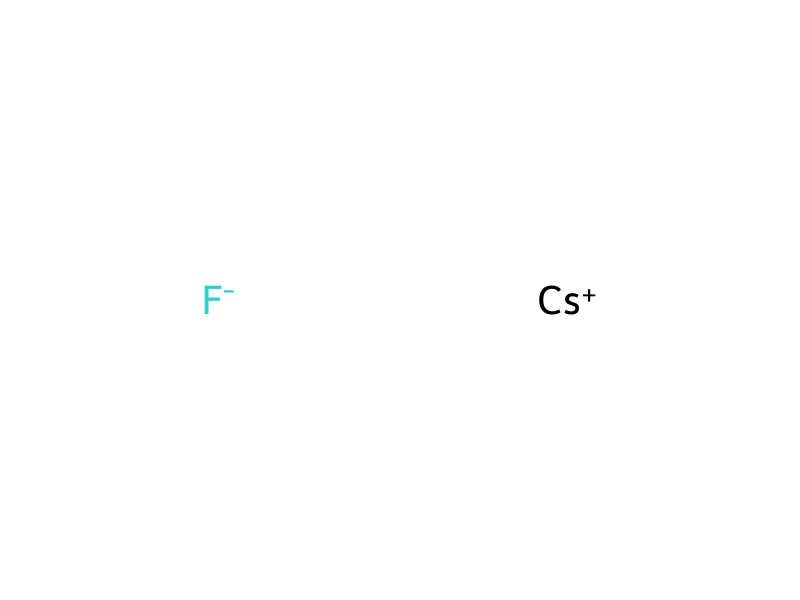
HCID 6422Trifluoroacetic acidHCID 25953Cesium fluorideHCID 6077842-(Tributylstannyl)pyridine2×HCID 901180792,4-Dichloro-6-(4-isopropoxyphenyl)pyridine

Product 1

HCID 901179274-Chloro-6-(4-isopropoxyphenyl)-2,2'-bipyridine

Reagents, catalysts & solvents 5

HCID 24350
Copper(1+) iodide; Copper(I) iodide; Cuprous iodide; Cuprous iodide (CuI)
Catalyst
HCID 178418397HCID 178418397, compoundCatalyst2×
HCID 887MethanolSolvent
HCID 962WaterSolvent
HCID 6228DimethylformamideSolvent

Procedure

To a 2 dram vial equipped with a stir bar was added 2,4-dichloro-6-(4-isopropoxyphenyl)pyridine (50 mg, 0.18 mmol), 2-(tributylstannyl)pyridine (65 mg, 0.18 mmol), CuI (8 mg, 0.04 mmol), CsF (81 mg, 0.53 mmol), and Pd(PPh3)4 (10 mg, 8.9 μmol). The vial was capped and then placed under N2 atmosphere. To the vial was added DMF (1 mL). The vial was placed in a 80° C. heating block with stirring for 1 h. The mixture was allowed to cool to room temperature. The vial was opened and to the reaction was added 2-(tributylstannyl)pyridine (65 mg, 0.18 mmol) and Pd(PPh3)4 (10 mg, 8.9 μmol). The vial was placed under N2 atmosphere and then returned to the 80° C. heating block with stirring for 1 h. The mixture was cooled to room temperature and then adsorbed onto diatomaceous earth (Celite®). The resulting powder was subjected to C18 chromatography (water:MeOH w/0.1% TFA) to afford 4-chloro-6-(4-isopropoxyphenyl)-2,2′-bipyridine as an amber solid. This material was carried forward into step 2.

Workup

  1. customTo a 2 dram vial equipped with a stir bar
  2. customThe vial was capped
  3. customwas placed in a 80° C.
  4. temperatureheating block
  5. customreturned to the 80° C.
  6. temperatureheating block
  7. stirringwith stirring for 1 h
  8. temperatureThe mixture was cooled to room temperature

Sources & evidence

ORD record
ord-a5a91a0b5c8c41e7955b7c7eb70fa215
Source dataset
uspto-grants-2016_05
DOI
10.6084/m9.figshare.5104873.v1
Patent number
US09334279B2

Reaction notes

On this pageParticipantsProcedureWorkupSources & evidenceReaction notes