HomeMCPWorkbenchSkills
HomeWorkbenchNotificationsMe
llms.txt · MCP GuidePrivacy Policy · Terms of Service · Supportv1.8.3
  1. Home
  2. /Reaction

Sodium Carbonate → 4-Chloro-6-cyclopropylthieno[2,3-d]pyrimidine

HRID 525075
Print

Reaction equation

HRID 525075 reaction equation
Br[C:2]1[S:11][C:5]2[N:6]=[CH:7][N:8]=[C:9]([Cl:10])[C:4]=2[CH:3]=1.[CH:12]1(B(O)O)[CH2:14][CH2:13]1.C(=O)([O-])[O-].[Na+].[Na+].C1C=CC(P(C2C=CC=CC=2)C2C=CC=CC=2)=CC=1>O.CC([O-])=O.CC([O-])=O.[Pd+2].CC1C=CC=CC=1>[Cl:10][C:9]1[C:4]2[CH:3]=[C:2]([CH:12]3[CH2:14][CH2:13]3)[S:11][C:5]=2[N:6]=[CH:7][N:8]=1
ParticipantsConditionsProcedureWorkupSources & evidenceReaction notes

Participants

8

Reactant 4

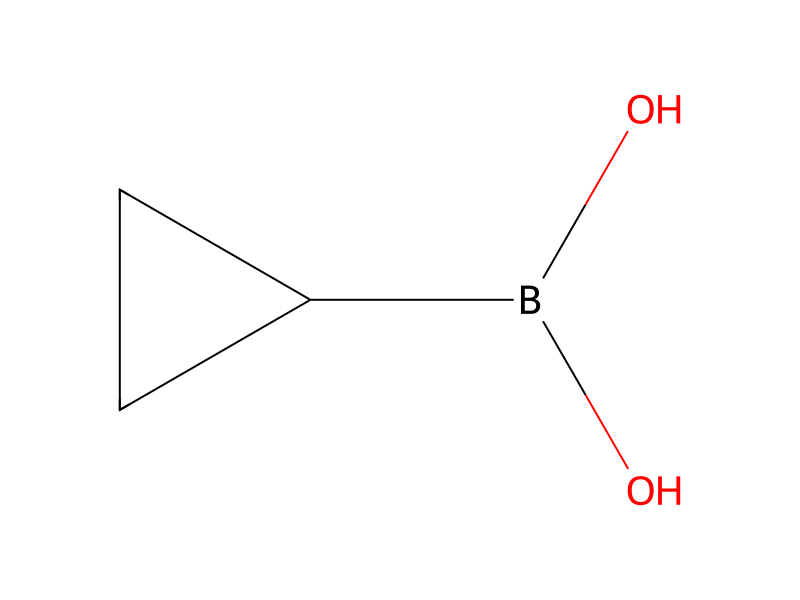
HCID 10340Sodium CarbonateHCID 11776TriphenylphosphineHCID 2760897Cyclopropylboronic acidHCID 122252616-Bromo-4-chlorothieno[2,3-d]pyrimidine

Product 1

HCID 885936684-Chloro-6-cyclopropylthieno[2,3-d]pyrimidine

Reagents, catalysts & solvents 3

HCID 167845
palladium(II) acetate
Catalyst
HCID 962WaterSolvent2×
HCID 1140TolueneSolvent

Conditions

Temperature
110 °C

Procedure

A 100-mL 3-necked round-bottom flask purged and maintained with an inert atmosphere of nitrogen was charged with commercially available 6-bromo-4-chlorothieno[2,3-d]pyrimidine (1.5 g, 6.01 mmol, 1.00 equiv), cyclopropylboronic acid (1.2 g, 13.97 mmol, 2.30 equiv), sodium carbonate (2.16 g, 20.38 mmol, 3.40 equiv), PPh3 (552 mg, 2.10 mmol, 0.35 equiv), Pd(OAc)2 (162 mg, 0.72 mmol, 0.12 equiv), water (7.5 mL) and methylbenzene (22.5 mL). The resulting solution was stirred overnight at 110° C. in an oil bath. The resulting solution was diluted with 50 mL of water. The resulting solution was extracted with 3×100 mL of dichloromethane and the organic layers combined. The resulting mixture was washed with 3×200 mL of brine. The mixture was dried over anhydrous sodium sulfate and concentrated under vacuum. The residue was applied onto a silica gel column with ethyl acetate/petroleum ether (1:15-1:5). This resulted in 400 mg (32%) of 4-chloro-6-cyclopropylthieno[2,3-d]pyrimidine as a yellow solid.


Workup

  1. customA 100-mL 3-necked round-bottom flask purged
  2. temperaturemaintained with an inert atmosphere of nitrogen
  3. extractionThe resulting solution was extracted with 3×100 mL of dichloromethane
  4. washThe resulting mixture was washed with 3×200 mL of brine
  5. dry with materialThe mixture was dried over anhydrous sodium sulfate
  6. concentrationconcentrated under vacuum
  7. customThis resulted in 400 mg (32%) of 4-chloro-6-cyclopropylthieno[2,3-d]pyrimidine as a yellow solid

Sources & evidence

ORD record
ord-6f9aede917f04a34a5864550ec553c85
Source dataset
uspto-grants-2016_05
DOI
10.6084/m9.figshare.5104873.v1
Patent number
US09340554B2

Reaction notes

On this pageParticipantsConditionsProcedureWorkupSources & evidenceReaction notes