Reaction equation
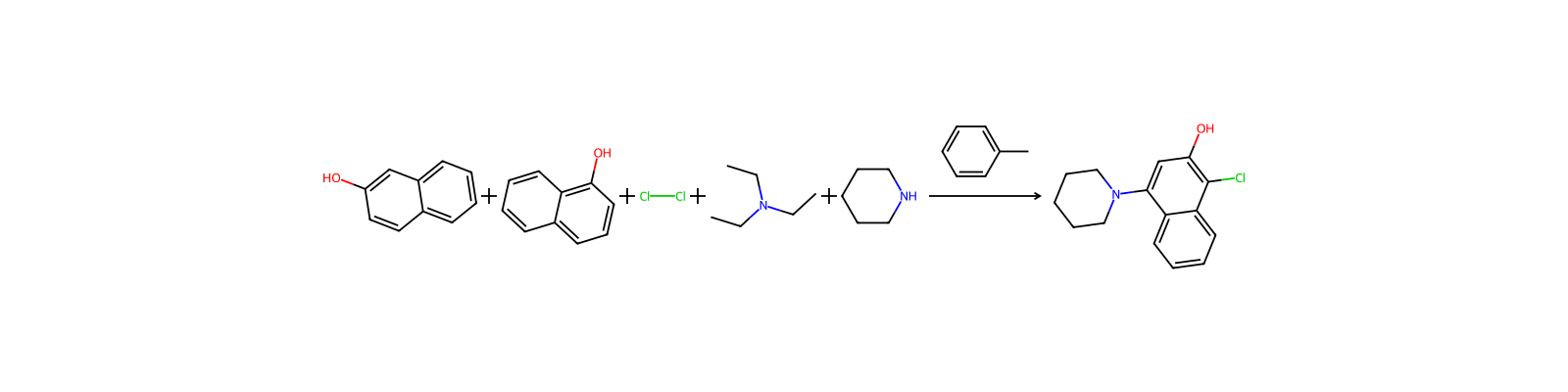
[CH:1]1[C:10]2[C:5](=[CH:6][CH:7]=[CH:8][CH:9]=2)[CH:4]=[CH:3][C:2]=1[OH:11].C1C=CC2C(=CC=CC=2O)C=1.[Cl:23]Cl.C(N(CC)CC)C.[NH:32]1[CH2:37][CH2:36][CH2:35][CH2:34][CH2:33]1>C1(C)C=CC=CC=1>[Cl:23][C:1]1[C:10]2[C:5](=[CH:6][CH:7]=[CH:8][CH:9]=2)[C:4]([N:32]2[CH2:37][CH2:36][CH2:35][CH2:34][CH2:33]2)=[CH:3][C:2]=1[OH:11]Participants
Reactant 5





Product 1

Reagents, catalysts & solvents 1

Procedure
2-Naphthol (28.8 g; 0.200 mol) was dissolved in toluene (210 ml) by warming. The pale brown solution was cooled and vigorously stirred until the naphthol began to precipitate and chlorine (30.20 g;0.425 mol) was then passed through the solution at approximately 2.5-3.0 g/min followed immediately by nitrogen gas. The resulting amber solution was treated firstly with triethylamine (24.68 g;0.244 mol) in one portion and then with a solution of piperidine (19.55 g;0.230 mol), in toluene (210 ml), dropwise over 1.5 hours keeping the temperature at 15°-20° C. The resulting brown mixture was filtered to remove triethylamine hydrochloride as a white amorphous solid. The toluene filtrate was washed in water, dried and evaporated to give 1-chloro-4-piperidino-2-naphthol (of structure 3a below) as a brown viscous oil (61.80 g;77% purity by gel permeation chromatography;91% yield based on 2-naphthol). Distillation gave the naphthol as a viscous amber gum B.Pt 150° C./0.3 mmHg. ##STR15## (b) 4-Piperidino-2-naphthol
Workup
- temperatureby warming
- temperatureThe pale brown solution was cooled
- customto precipitate
- customat 15°-20° C
- filtrationThe resulting brown mixture was filtered
- customto remove triethylamine hydrochloride as a white amorphous solid
- washThe toluene filtrate was washed in water
- customdried
- customevaporated
Sources & evidence
- ORD record
- ord-61666f86d1ce48528781809429ebc77f
- Source dataset
- uspto-grants-1997_04
- Patent number
- US05623005
Linked notes
Loading…