Reaction equation
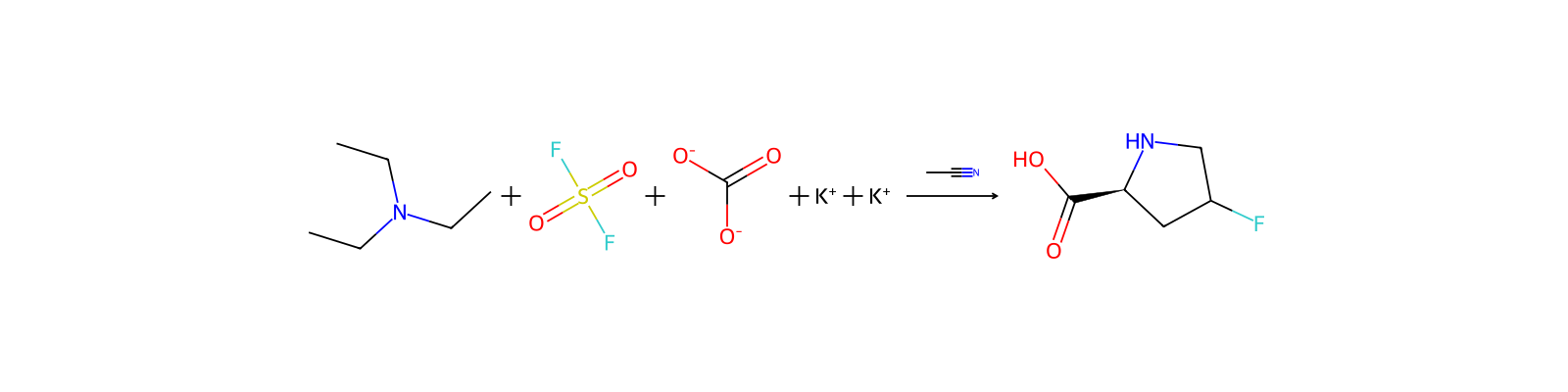
[CH2:1]([N:3](CC)[CH2:4][CH3:5])[CH3:2].S(F)([F:11])(=O)=O.[C:13](=[O:16])([O-])[O-:14].[K+].[K+]>C(#N)C>[F:11][CH:5]1[CH2:4][NH:3][C@H:1]([C:13]([OH:14])=[O:16])[CH2:2]1Participants
Reactant 3


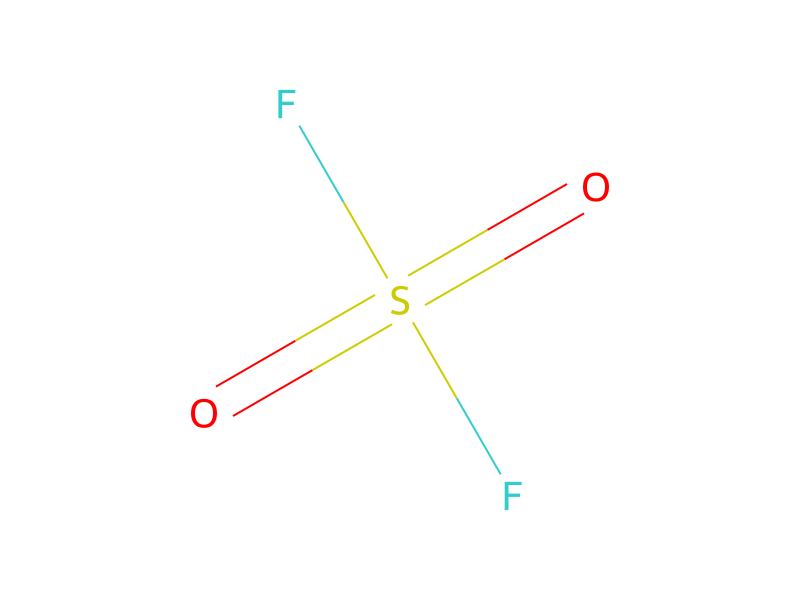
Product 1

Reagents, catalysts & solvents 1

Procedure
10.0 mL of acetonitrile, and 1.10 g (10.87 mmol, 1.09 eq) of triethylamine, followed by lowering the inside temperature to −40° C. and then bubbling 2.00 g (19.60 mmol, 1.96 eq) of sulfuryl fluoride from a cylinder. The inside temperature was returned to room temperature, and stirring was conducted for 20 hours and 20 minutes. Conversion of the reaction was found by gas chromatography measurement to be 100%. The reaction-terminated liquid was poured into a potassium carbonate aqueous solution [prepared from 2.80 g (20.26 mmol, 2.03 eq) of potassium carbonate and 50.0 mL of water], followed by extraction two times with 50.0 mL of ethyl acetate. The recovered organic layer was concentrated under reduced pressure, followed by vacuum drying, thereby obtaining a crude product of 4-fluoroproline derivative represented by the following formula,
Workup
- customto −40° C.
- customwas returned to room temperature
- extractionfollowed by extraction two times with 50.0 mL of ethyl acetate
- concentrationThe recovered organic layer was concentrated under reduced pressure
- customdrying
Sources & evidence
- ORD record
- ord-c1b4b1885cbc441a8ce03ccc5ebb84de
- Source dataset
- uspto-grants-2011_11
- Patent number
- US08058412B2
Linked notes
Loading…