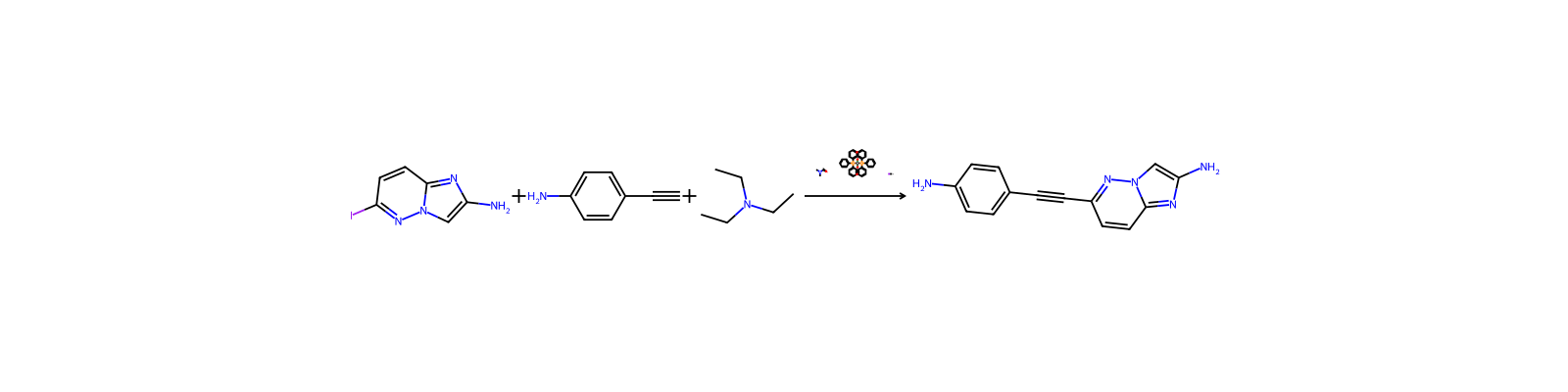
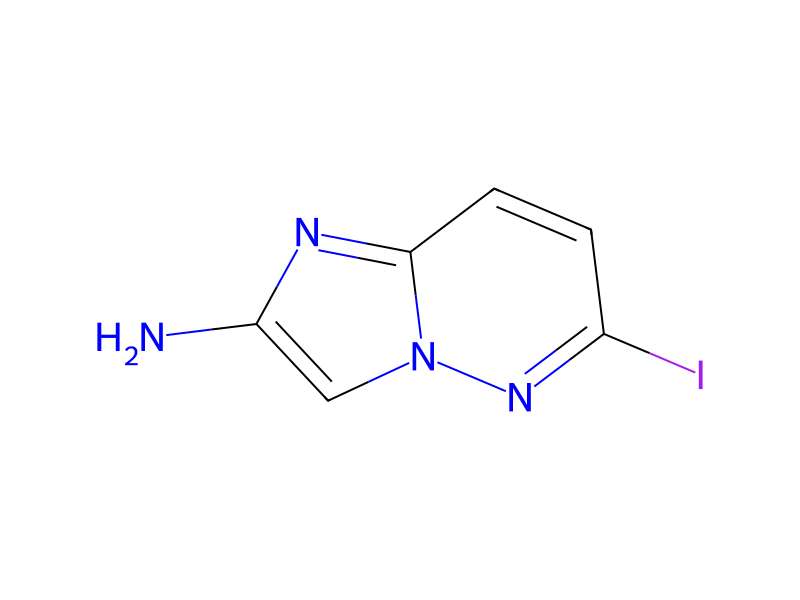
I[C:2]1[CH:3]=[CH:4][C:5]2[N:6]([CH:8]=[C:9]([NH2:11])[N:10]=2)[N:7]=1.[C:12]([C:14]1[CH:20]=[CH:19][C:17]([NH2:18])=[CH:16][CH:15]=1)#[CH:13].C(N(CC)CC)C>CN(C=O)C.Cl[Pd](Cl)([P](C1C=CC=CC=1)(C1C=CC=CC=1)C1C=CC=CC=1)[P](C1C=CC=CC=1)(C1C=CC=CC=1)C1C=CC=CC=1.[Cu]I>[NH2:18][C:17]1[CH:19]=[CH:20][C:14]([C:12]#[C:13][C:2]2[CH:3]=[CH:4][C:5]3[N:6]([CH:8]=[C:9]([NH2:11])[N:10]=3)[N:7]=2)=[CH:15][CH:16]=1To the mixture of 6-iodo-imidazo[1,2-b]pyridazin-2-ylamine (780 mg, 3.0 mmol, 1 eq) and 4-ethynylaniline (543 mg, 1.5 eq) in anhydrous DMF (10 mL) under nitrogen atmosphere was added triethylamine (1.67 mL, 4 eq), bis(triphenylphosphine)palladium(II) dichloride (210 mg, 0.1 eq) and copper(I) iodide (114 mg, 0.2 eq). After the reaction mixture was stirred at 50° C. for 30 minutes, it was partitioned between saturated aqueous sodium bicarbonate and chloroform (containing 3% v/v of MeOH). The organic layer was separated and washed with aqueous ammonium chloride, brine, and lastly dried with anhydrous sodium sulfate. The upper suspension mixture was decanted, concentrated, and the solid residue was subject to a gradient column chromatography (from CHCl3 to MeOH—CHCl3 1:30) to give 6-[(4-aminophenyl)ethynyl]imidazo[1,2-b]pyridazin-2-amine as a yellow solid in amount of 166 mg.
Loading…