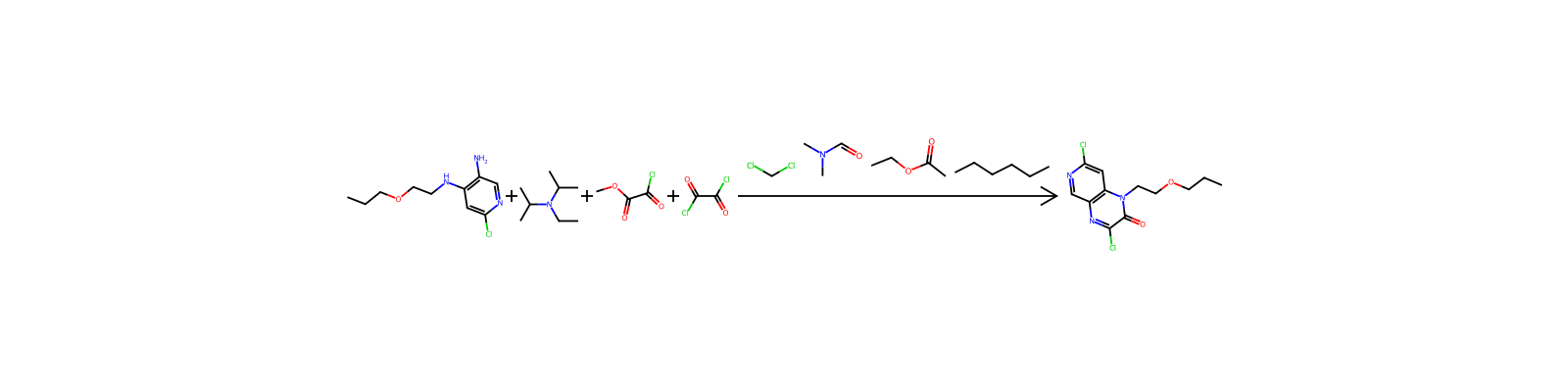
A 0° C. solution of 6-chloro-N4-(2-propoxyethyl)pyridine-3,4-diamine (2.80 g, 12.2 mmol) and diisopropylethylamine (4.6 mL, 25.7 mmol) in dichloromethane (100 mL) was treated with methyl chlorooxoacetate (1.1 mL, 11.7 mmol, Aldrich), allowed to warm to room temperature and stirred for four hours. The reaction was diluted with dichloromethane and washed with saturated sodium bicarbonate solution, dried over magnesium sulfate, and solvent was removed at reduced pressure. The residue was dissolved in toluene (30 mL) and heated at 105° C. for four hours. The solvent was removed at reduced pressure and the resulting solid taken up in dichloromethane (100 mL) and treated with oxalyl chloride (2.1 mL, 24.1 mmol) and DMF (3 drops). The reaction was stirred at room temperature for 6 hours. The solvent was removed at reduced pressure to give a brown solid. This was passed through a column of silica gel with 70% ethyl acetate/hexane to give 3,7-dichloro-1-(2-propoxyethyl)pyrido[3,4-b]pyrazin-2(1H)-one as a white solid. (2.44 g, 66% yield). 1H NMR (CDCl3) δ 8.78 (1H), 7.59 (1H), 4.40 (2H), 3.80 (2H), 3.35 (2H), 1.52-1.46 (2H), 0.82 (3H).