HomeMCPWorkbenchSkills
HomeWorkbenchNotificationsMe
llms.txt · MCP GuidePrivacy Policy · Terms of Service · Supportv1.8.1
  1. Home
  2. /Reaction

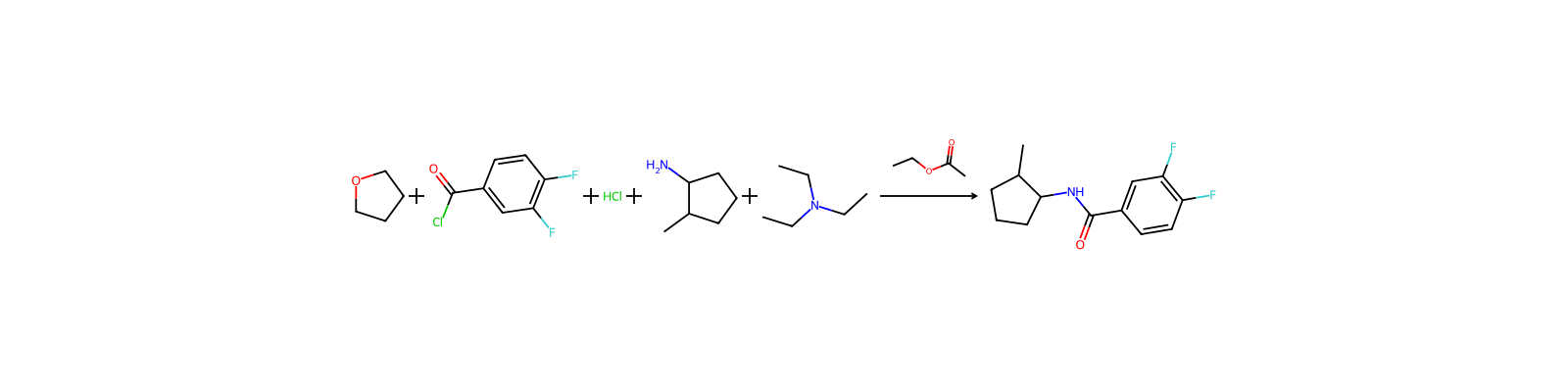
Tetrahydrofuran → N-(2-methylcyclopentyl)-3,4-difluorobenzamide

HRID 602000
Print

Reaction equation

HRID 602000 reaction equation
C1COCC1.[F:6][C:7]1[CH:8]=[C:9]([CH:13]=[CH:14][C:15]=1[F:16])[C:10](Cl)=[O:11].Cl.[CH3:18][CH:19]1[CH2:23][CH2:22][CH2:21][CH:20]1[NH2:24].C(N(CC)CC)C>C(OCC)(=O)C>[CH3:18][CH:19]1[CH2:23][CH2:22][CH2:21][CH:20]1[NH:24][C:10](=[O:11])[C:9]1[CH:13]=[CH:14][C:15]([F:16])=[C:7]([F:6])[CH:8]=1
ParticipantsProcedureWorkupSources & evidenceReaction notes

Participants

6

Reactant 4

HCID 8028TetrahydrofuranHCID 8471TriethylamineHCID 27245193,4-Difluorobenzoyl chlorideHCID 191014392-Methylcyclopentan-1-amine hydrochloride

Product 1

HCID 57445707N-(2-methylcyclopentyl)-3,4-difluorobenzamideYield 84.3%

Reagents, catalysts & solvents 1

HCID 8857
Ethyl Acetate
Solvent

Procedure

To a mixture of 10 ml of THF and 0.60 g of 3,4-difluorobenzoyl chloride were added 0.37 g of 2-methylcyclopentylamine hydrochloride and 1.0 g of triethylamine, and the mixture obtained was stirred at room temperature for 3 hours. Then, ethyl acetate was added to the reaction mixture and filtered through Celite. The filtrate was concentrated under reduced pressure. The residue was subjected to silica gel column chromatography to obtain 0.55 g of N-(2-methylcyclopentyl)-3,4-difluorobenzamide.

Workup

  1. customthe mixture obtained
  2. filtrationfiltered through Celite
  3. concentrationThe filtrate was concentrated under reduced pressure

Sources & evidence

ORD record
ord-8ab286347c77495d9716b68571a0fd09
Source dataset
uspto-grants-2011_03
DOI
10.6084/m9.figshare.5104873.v1
Patent number
US07902400B2

Reaction notes

On this pageParticipantsProcedureWorkupSources & evidenceReaction notes