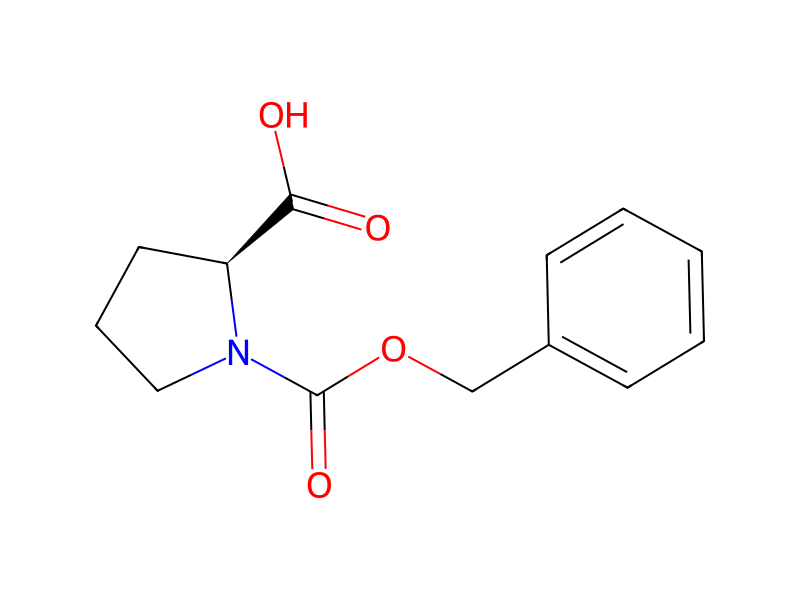
[C:1](Cl)(=O)C(Cl)=O.CN(C)C=O.C(#N)C.[C:15]([N:25]1[CH2:32][CH2:31][CH2:30][C@H:26]1[C:27]([OH:29])=[O:28])([O:17][CH2:18][C:19]1[CH:24]=[CH:23][CH:22]=[CH:21][CH:20]=1)=[O:16].N1[CH:38]=[CH:37][CH:36]=CC=1>C(O)(C)(C)C>[C:37]([O:28][C:27](=[O:29])[C@@H:26]1[CH2:30][CH2:31][CH2:32][N:25]1[C:15]([O:17][CH2:18][C:19]1[CH:24]=[CH:23][CH:22]=[CH:21][CH:20]=1)=[O:16])([CH3:36])([CH3:38])[CH3:1]126.9 (1 mol) of oxalyl chloride is added dropwise over 15 minutes to a stirred mixture of 200 ml absolute dimethylformamide and 500 ml absolute acetonitrile cooled to -20°. The solution is stirred for a further 15 minutes at -20° and then 249 g (1 mol) N-carbobenzoxy-L-proline is added. After 15 minutes of stirring, the mixture is treated dropwise with a mixture of 250 ml of absolute tert.-butanol and 200 ml absolute pyridine at such a rate that the temperature of the mixture does not rise above -15°. Cooling of the mixture is then stopped, and the mixture is maintained at room temperature for 3 hours. The mixture is worked up by partitioning between 2N sodium carbonate solution and methylene chloride and obtaining the heading compound from the methylene chloride phase as an oil nD23 = 1.5015 which slowly crystallizes out.