Reaction equation
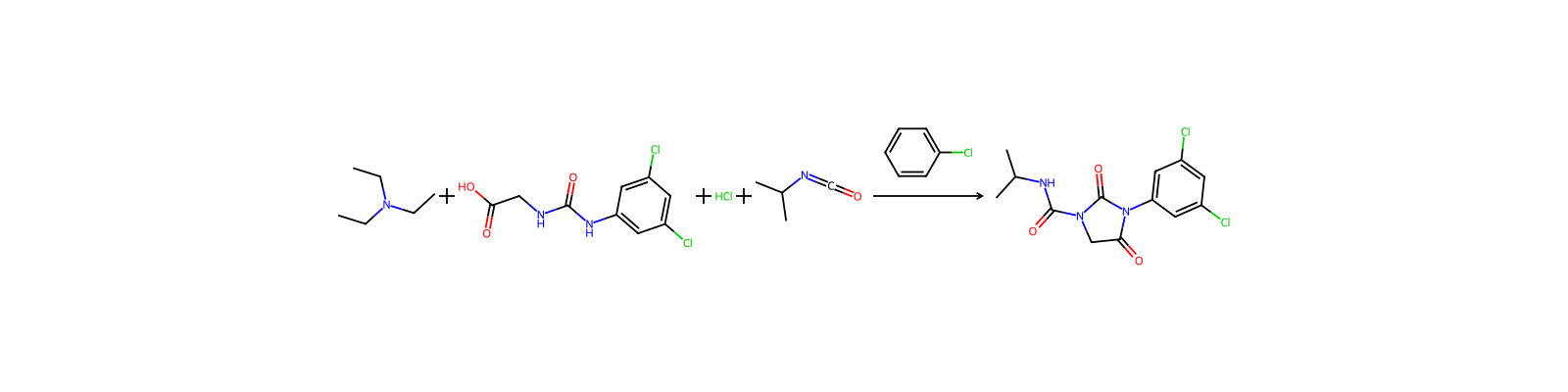
C(N(CC)CC)C.[Cl:8][C:9]1[CH:10]=[C:11]([NH:16][C:17](=[O:23])[NH:18][CH2:19][C:20]([OH:22])=O)[CH:12]=[C:13]([Cl:15])[CH:14]=1.Cl.[CH:25]([N:28]=[C:29]=[O:30])([CH3:27])[CH3:26]>ClC1C=CC=CC=1>[CH:25]([NH:28][C:29]([N:18]1[CH2:19][C:20](=[O:22])[N:16]([C:11]2[CH:12]=[C:13]([Cl:15])[CH:14]=[C:9]([Cl:8])[CH:10]=2)[C:17]1=[O:23])=[O:30])([CH3:27])[CH3:26]Participants
6
Reactant 4




Product 1
Reagents, catalysts & solvents 1

Conditions
- Temperature
- 50 °C
Procedure
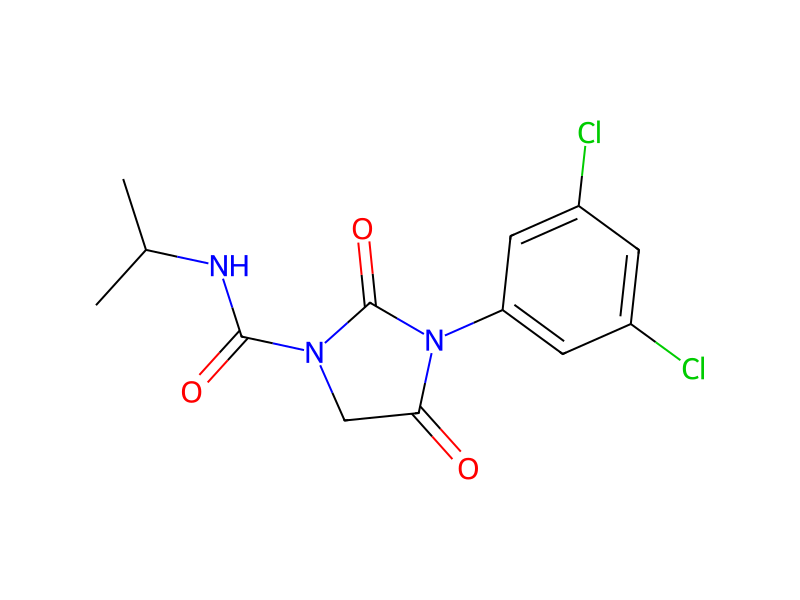
101 g of triethylamine are added to a suspension of 263 g of 2-[3-(3,5-dichlorophenyl)-ureido]-acetic acid in 2,000 cm3 of chlorobenzene and 300 g of isopropyl isocyanate, which has been heated to 50° C, and the mixture is stirred for 4 hours at 80°-90°. After cooling, the reaction mixture is stirred for 30 minutes with 500 cm3 of a 7% strength (weight/volume) aqueous solution of hydrochloric acid. The organic solution is decanted, dried and concentrated under reduced pressure. 332 g of 1-isopropylcarbamoyl-3-(3,5-dichlorophenyl)-hydantoin melting at 130° C are thus obtained.
Workup
- temperatureAfter cooling
- customThe organic solution is decanted
- customdried
- concentrationconcentrated under reduced pressure
Sources & evidence
- ORD record
- ord-9783e2e49edf49a3a030f93600e2b706
- Source dataset
- uspto-grants-1978_02
- Patent number
- US04076941
Linked notes
Loading…