HomeMCPWorkbenchSkills
HomeWorkbenchNotificationsMe
llms.txt · MCP GuidePrivacy Policy · Terms of Service · Supportv1.8.3
  1. Home
  2. /Reaction

Potassium Carbonate → Methyl 1-(5-(4-methylpyridin-2-yl)pyrimidin-2-yl)-3-(methylthio)-1H-indole-6-carboxylate

HRID 630515
Print

Reaction equation

HRID 630515 reaction equation
Br[C:2]1[CH:3]=[N:4][C:5]([N:8]2[C:16]3[C:11](=[CH:12][CH:13]=[C:14]([C:17]([O:19][CH3:20])=[O:18])[CH:15]=3)[C:10]([S:21][CH3:22])=[CH:9]2)=[N:6][CH:7]=1.B1(B2OC(C)(C)C(C)(C)O2)OC(C)(C)C(C)(C)O1.C([O-])(=O)C.[K+].Br[C:47]1[CH:52]=[C:51]([CH3:53])[CH:50]=[CH:49][N:48]=1.C(=O)([O-])[O-].[K+].[K+]>O1CCOCC1.C1C=CC(P(C2C=CC=CC=2)[C-]2C=CC=C2)=CC=1.C1C=CC(P(C2C=CC=CC=2)[C-]2C=CC=C2)=CC=1.Cl[Pd]Cl.[Fe+2].C1C=CC([P]([Pd]([P](C2C=CC=CC=2)(C2C=CC=CC=2)C2C=CC=CC=2)([P](C2C=CC=CC=2)(C2C=CC=CC=2)C2C=CC=CC=2)[P](C2C=CC=CC=2)(C2C=CC=CC=2)C2C=CC=CC=2)(C2C=CC=CC=2)C2C=CC=CC=2)=CC=1>[CH3:53][C:51]1[CH:50]=[CH:49][N:48]=[C:47]([C:2]2[CH:3]=[N:4][C:5]([N:8]3[C:16]4[C:11](=[CH:12][CH:13]=[C:14]([C:17]([O:19][CH3:20])=[O:18])[CH:15]=4)[C:10]([S:21][CH3:22])=[CH:9]3)=[N:6][CH:7]=2)[CH:52]=1


ParticipantsProcedureWorkupSources & evidenceReaction notes

Participants

9

Reactant 5

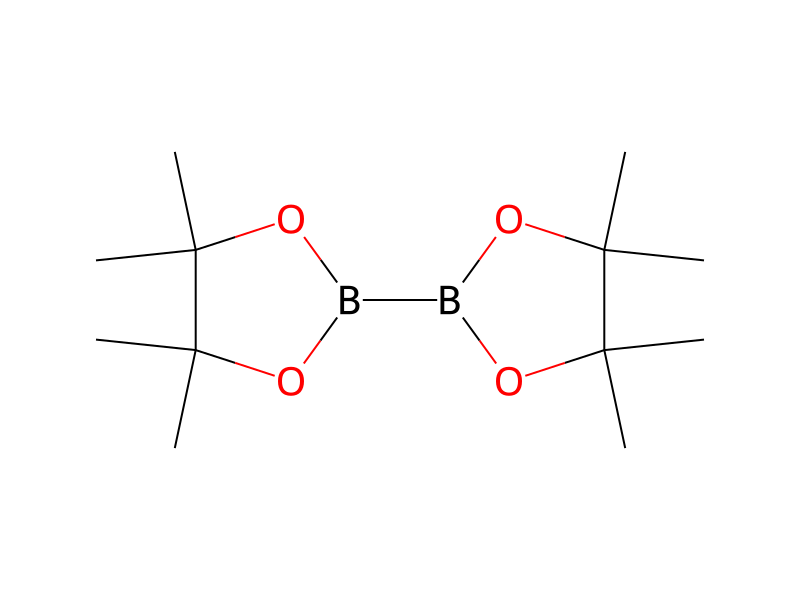
HCID 11430Potassium CarbonateHCID 517044Potassium AcetateHCID 2733548Bis(pinacolato)diboraneHCID 27340872-Bromo-4-methylpyridineHCID 118666039Methyl 1-(5-bromopyrimidin-2-yl)-3-(methylthio)-1H-indole-6-carboxylate

Product 1

HCID 118676909
Methyl 1-(5-(4-methylpyridin-2-yl)pyrimidin-2-yl)-3-(methylthio)-1H-indole-6-carboxylate

Reagents, catalysts & solvents 3

HCID 44119782Bis(cyclopenta-1,4-dien-1-yl(diphenyl)phosphane);dichloropalladium;iron(2+)CatalystHCID 178418397HCID 178418397, compoundCatalystHCID 312751,4-DioxaneSolvent

Procedure

PdCl2(dppf) (0.325 g, 0.397 mmol) was added to a suspension of methyl 1-(5-bromopyrimidin-2-yl)-3-(methylthio)-1H-indole-6-carboxylate (3.0 g, 7.96 mmol), bis(pinacolato)diboron (2.26 g, 8.91 mmol) and potassium acetate (2.34 g, 23.87 mmol) in dioxane (80 mL) that was stirred under an argon atmosphere. The reaction mixture was stirred for 1 h at 110° C. and then cooled to room temperature. 2-Bromo-4-methyl-pyridine (2.05 g, 11.93 mmol), 2M potassium carbonate solution (8.0 mL) and tetrakis(triphenylphosphine)palladium(0) (0.46 g, 0.398 mmol) were added at this temperature and the resulting mixture was stirred for 16 h at 100° C. The reaction mixture was filtered through a pad of celite, the filter was washed with dichloromethane/methanol (9:1) and the filtrate was concentrated under reduced pressure. The remnant was purified by column chromatography [100-200 mesh silica; dichloromethane ethyl acetate/hexane=5/20/75]. Yellow solid. Yield: 2.0 g (64% of theory)

Workup

  1. stirringThe reaction mixture was stirred for 1 h at 110° C.
  2. stirringthe resulting mixture was stirred for 16 h at 100° C
  3. filtrationThe reaction mixture was filtered through a pad of celite
  4. washthe filter was washed with dichloromethane/methanol (9:1)
  5. concentrationthe filtrate was concentrated under reduced pressure
  6. customThe remnant was purified by column chromatography [100-200 mesh silica; dichloromethane ethyl acetate/hexane=5/20/75]

Sources & evidence

ORD record
ord-48e7b0e1e5724905bfb8a5ee966b6e0d
Source dataset
uspto-grants-2016_04
DOI
10.6084/m9.figshare.5104873.v1
Patent number
US09315490B2

Reaction notes

On this pageParticipantsProcedureWorkupSources & evidenceReaction notes