HomeMCPWorkbenchSkills
HomeWorkbenchNotificationsMe
llms.txt · MCP GuidePrivacy Policy · Terms of Service · Supportv1.8.0
  1. Home
  2. /Reaction

Hydrochloric Acid → mono N-hydroxysuccinimide glutarate

HRID 6335
Notes
Print preview

Reaction equation

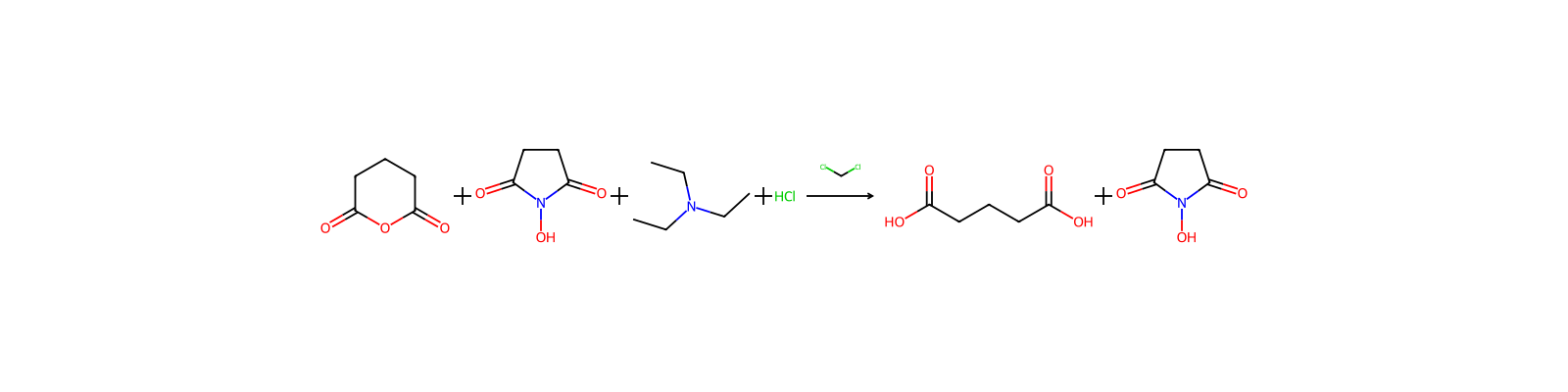
HRID 6335 reaction equation
[C:1]1(=[O:8])[O:7][C:5](=[O:6])[CH2:4][CH2:3][CH2:2]1.[OH:9][N:10]1[C:14](=[O:15])[CH2:13][CH2:12][C:11]1=[O:16].C(N(CC)CC)C.Cl>ClCCl>[C:1]([OH:7])(=[O:8])[CH2:2][CH2:3][CH2:4][C:5]([OH:9])=[O:6].[OH:9][N:10]1[C:14](=[O:15])[CH2:13][CH2:12][C:11]1=[O:16]
ParticipantsProcedureWorkupSources & evidenceReaction notes

Participants

6

Reactant 4

HCID 313Hydrochloric AcidHCID 7940Glutaric anhydrideHCID 8471TriethylamineHCID 80170N-Hydroxysuccinimide

Product 1

HCID 19793121mono N-hydroxysuccinimide glutarate

Reagents, catalysts & solvents 1

HCID 6344DichloromethaneSolvent

Procedure

One mole of glutaric anhydride and one mole of N-hydroxysuccinimide were treated in dichloromethane with 1.2 equivalents of triethylamine. This reaction was stirred for 40 minutes, acidified by the addition of 0.5N hydrochloric acid (HCl) (aqueous), and then extracted with ethyl acetate to form mono N-hydroxysuccinimide glutarate. This glutarate was then combined with 5 moles of thionyl chloride and stirred at room temperature for three hours. The resulting reaction mixture was dried to remove volatiles, and thereby form N-hydroxysuccinimidyl glutaryl chloride.

Workup

  1. extractionextracted with ethyl acetate

Sources & evidence

ORD record
ord-1ed7b4f414b94a45a886575dff6a9247
Source dataset
uspto-grants-1993_09
DOI
10.6084/m9.figshare.5104873.v1
Patent number
US05248611

Reaction notes

Loading…

On this pageParticipantsProcedureWorkupSources & evidenceReaction notes