HomeMCPWorkbenchSkills
HomeWorkbenchNotificationsMe
llms.txt · MCP GuidePrivacy Policy · Terms of Service · Supportv1.8.0
  1. Home
  2. /Reaction

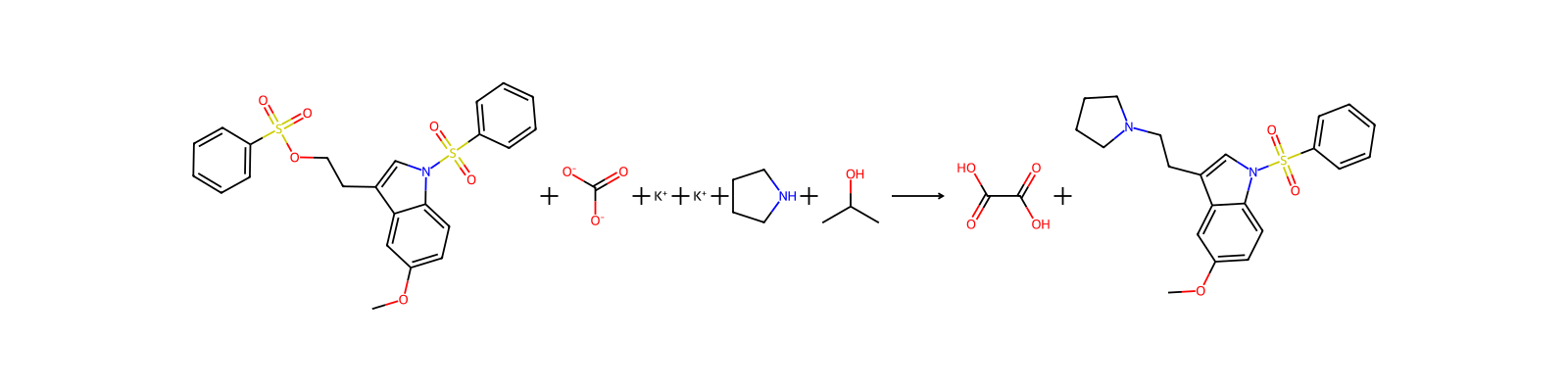
Isopropanol → 1-Benzenesulphonyl-5-methoxy-3-[(2-pyrrolidin-1-yl)ethyl]-1H-indole Hydrogen Oxalate

HRID 635382
Notes
Print preview

Reaction equation

HRID 635382 reaction equation
[C:1]1([S:7]([N:10]2[C:18]3[C:13](=[CH:14][C:15]([O:19][CH3:20])=[CH:16][CH:17]=3)[C:12]([CH2:21][CH2:22][O:23]S(C3C=CC=CC=3)(=O)=O)=[CH:11]2)(=[O:9])=[O:8])[CH:6]=[CH:5][CH:4]=[CH:3][CH:2]=1.[C:33](=[O:36])([O-:35])[O-].[K+].[K+].[NH:39]1[CH2:43][CH2:42][CH2:41][CH2:40]1.CC([OH:47])C>>[C:22]([OH:23])(=[O:47])[C:33]([OH:35])=[O:36].[C:1]1([S:7]([N:10]2[C:18]3[C:13](=[CH:14][C:15]([O:19][CH3:20])=[CH:16][CH:17]=3)[C:12]([CH2:21][CH2:22][N:39]3[CH2:43][CH2:42][CH2:41][CH2:40]3)=[CH:11]2)(=[O:9])=[O:8])[CH:6]=[CH:5][CH:4]=[CH:3][CH:2]=1
ParticipantsProcedureWorkupSources & evidenceReaction notes

Participants

5

Reactant 4

HCID 3776Isopropanol2×HCID 11430Potassium CarbonateHCID 31268PyrrolidineHCID 11762460benzenesulphonic acid 2-(1-benzenesulphonyl-5-methoxy-1H-indol-3-yl)ethyl ester

Product 1

HCID 212585631-Benzenesulphonyl-5-methoxy-3-[(2-pyrrolidin-1-yl)ethyl]-1H-indole Hydrogen OxalateYield 65%

Procedure

To a stirred solution of benzenesulphonic acid 2-(1-benzenesulphonyl-5-methoxy-1H-indol-3-yl)ethyl ester (0.191 g, 0.405 mmol) in anhydrous 2-propanol (10 ml) under nitrogen was added anhydrous potassium carbonate (0.112 g, 0.810 mmol), then a solution of pyrrolidine (0.17 ml, 2.03 mmol) in anhydrous 2-propanol (3 ml). The mixture was heated at reflux for 4 h, and the solvents were then removed in vacuo. The residue was partitioned between dichloromethane and water, and the aqueous layer was extracted further with dichloromethane. The combined organic extracts were washed with brine (2×25 ml), dried (Na2SO4), and evaporated in vacuo. The residue was purified by flash chromatography (silica gel, CH2Cl2—MeOH—NH3; 95:5:0.5) to give 0.102 g (65%) of the title compound free base. The oxalate salt was prepared in EtOH-Et2O as a white solid; mp 217°-220° C.; δH (360 MHz, d6-DMSO) 1.94 (4H, s), 3.03 (2H, m), 3.27 (4H, s), 3.40 (2H, m), 3.79 (3H, s), 6.98 (1H, dd, J=9.0, 2.3 Hz), 7.17 (1H, d, J=2.3 Hz), 7.58 (2H, t, J=8.0 Hz), 7.69 (2H, m), 7.82 (1H, d, J=9.0 Hz), 7.92 (2H, d, J=7.9 Hz); m/z (ES+) 385 (MH30 ). Found: C, 57.83; H, 5.31; N, 5.87. C21H24N2O3S.C2H2O4 requires C, 58.22; H, 5.52; N, 5.90%.

Workup

  1. temperatureThe mixture was heated
  2. temperatureat reflux for 4 h
  3. customthe solvents were then removed in vacuo
  4. customThe residue was partitioned between dichloromethane and water
  5. extractionthe aqueous layer was extracted further with dichloromethane
  6. washThe combined organic extracts were washed with brine (2×25 ml)
  7. dry with materialdried (Na2SO4)
  8. customevaporated in vacuo
  9. customThe residue was purified by flash chromatography (silica gel, CH2Cl2—MeOH—NH3; 95:5:0.5)

Sources & evidence

ORD record
ord-811ee4f4c3e6424b99addb7617f0a8f3
Source dataset
uspto-grants-2001_02
DOI
10.6084/m9.figshare.5104873.v1
Patent number
US06187805B1

Reaction notes

Loading…

On this pageParticipantsProcedureWorkupSources & evidenceReaction notes