HomeMCPWorkbenchSkills
HomeWorkbenchNotificationsMe
llms.txt · MCP GuidePrivacy Policy · Terms of Service · Supportv1.8.3
  1. Home
  2. /Reaction

Picolyl chloride → 2-Pyridin-2-ylmethyl-piperazine-1,2,4-tricarboxylic acid 1-benzyl ester 4-tert-butyl ester 2-methyl ester

HRID 636832
Print

Reaction equation

HRID 636832 reaction equation
[CH3:1][O:2][C:3]([CH:5]1[CH2:10][N:9]([C:11]([O:13][C:14]([CH3:17])([CH3:16])[CH3:15])=[O:12])[CH2:8][CH2:7][N:6]1[C:18]([O:20][CH2:21][C:22]1[CH:27]=[CH:26][CH:25]=[CH:24][CH:23]=1)=[O:19])=[O:4].C[Si]([N-][Si](C)(C)C)(C)C.[K+].[N:38]1[CH:43]=[CH:42][CH:41]=[CH:40][C:39]=1[CH2:44]Cl.C(=O)(O)[O-].[Na+]>O1CCCC1.CN(C=O)C.C(Cl)Cl>[CH3:1][O:2][C:3]([C:5]1([CH2:44][C:39]2[CH:40]=[CH:41][CH:42]=[CH:43][N:38]=2)[CH2:10][N:9]([C:11]([O:13][C:14]([CH3:17])([CH3:15])[CH3:16])=[O:12])[CH2:8][CH2:7][N:6]1[C:18]([O:20][CH2:21][C:22]1[CH:27]=[CH:26][CH:25]=[CH:24][CH:23]=1)=[O:19])=[O:4]
ParticipantsProcedureWorkupSources & evidenceReaction notes

Participants

8

Reactant 4

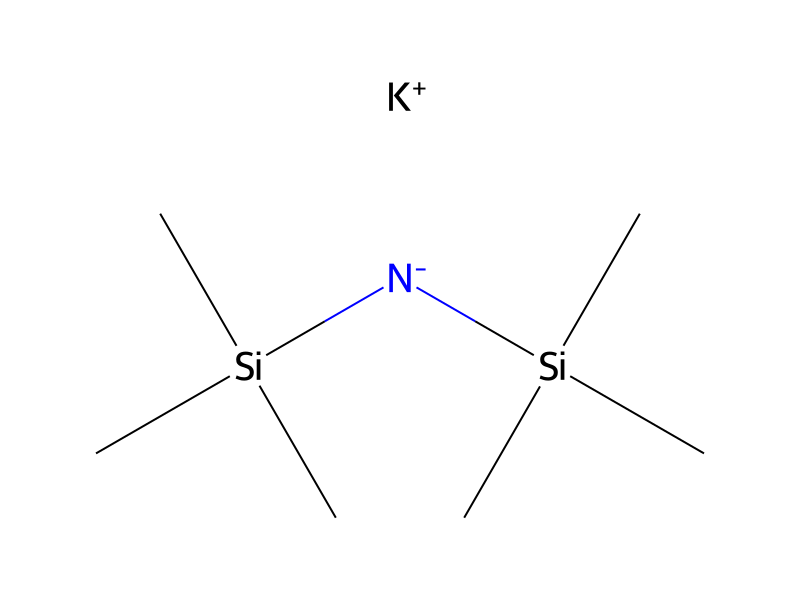
HCID 23393Picolyl chlorideHCID 516892Sodium BicarbonateHCID 3251421Potassium bis(trimethylsilyl)amideHCID 44519651-Benzyl 4-tert-butyl 2-methyl piperazine-1,2,4-tricarboxylate

Product 1

HCID 539190472-Pyridin-2-ylmethyl-piperazine-1,2,4-tricarboxylic acid 1-benzyl ester 4-tert-butyl ester 2-methyl ester

Reagents, catalysts & solvents 3

HCID 6228DimethylformamideSolventHCID 6344DichloromethaneSolventHCID 8028TetrahydrofuranSolvent2×

Procedure

A stirred solution of piperazine-1,2,4-tricarboxylic acid 1-benzyl ester 4-tert-butyl ester 2-methyl ester (200 g, 529 mol) in tetrahydrofuran (200 mL) and DMF (1.5 L) was cooled to −78° C. under a nitrogen atmosphere, and a 0.5 M solution of potassium bis(trimethylsilyl)amide in THF (1.27 L) was added. After the above solution had stirred about one hour, the free base of 2-picolyl chloride was generated by extracting the corresponding hydrochloride salt (217 g, 1.32 mol) from saturated sodium bicarbonate solution with methylene chloride. The combined organic extracts were dried (MgSO4), concentrated, immediately dissolved in DMF (100 mL), and then added dropwise to the enolate containing solution. The reaction was stirred for about 4 hours at −78° C., then slowly warmed to room temperature and stirred overnight. The toluene and THF were removed under reduced pressure. The residue was extracted from water (1.5 L) with ethyl acetate (3×1 L), the combined extracts were then washed with water (1.5 L), dried (MgSO4) and then concentrated in vacuo to give 240 g of crude title compound of part 5-A which carried on to the next step: +APcI MS (M+H)+ 470; 1H NMR=400 MHz (methanol-d4) δ8.4 (arom, m, 1H), 7.65-7.2 (arom, m, 7H), 6.94 (arom, m, 1H), 5.18 (CbzNCHH, m, 1H), 5.05 (CbzNCHH, m, 1H), 2.54 (m, 1H), 1.41 (Boc, s, 9H).

Workup

  1. dry with materialThe combined organic extracts were dried (MgSO4)
  2. concentrationconcentrated
  3. dissolutionimmediately dissolved in DMF (100 mL)
  4. additionadded dropwise to the enolate containing solution
  5. stirringThe reaction was stirred for about 4 hours at −78° C.
  6. stirringstirred overnight
  7. customThe toluene and THF were removed under reduced pressure
  8. extractionThe residue was extracted from water (1.5 L) with ethyl acetate (3×1 L)
  9. washthe combined extracts were then washed with water (1.5 L)
  10. dry with materialdried (MgSO4)
  11. concentrationconcentrated in vacuo

Sources & evidence

ORD record
ord-d79a0defaf084907b85147284415366e
Source dataset
uspto-grants-2001_02
DOI
10.6084/m9.figshare.5104873.v1
Patent number
US06194578B1

Reaction notes

On this pageParticipantsProcedureWorkupSources & evidenceReaction notes