Reaction equation
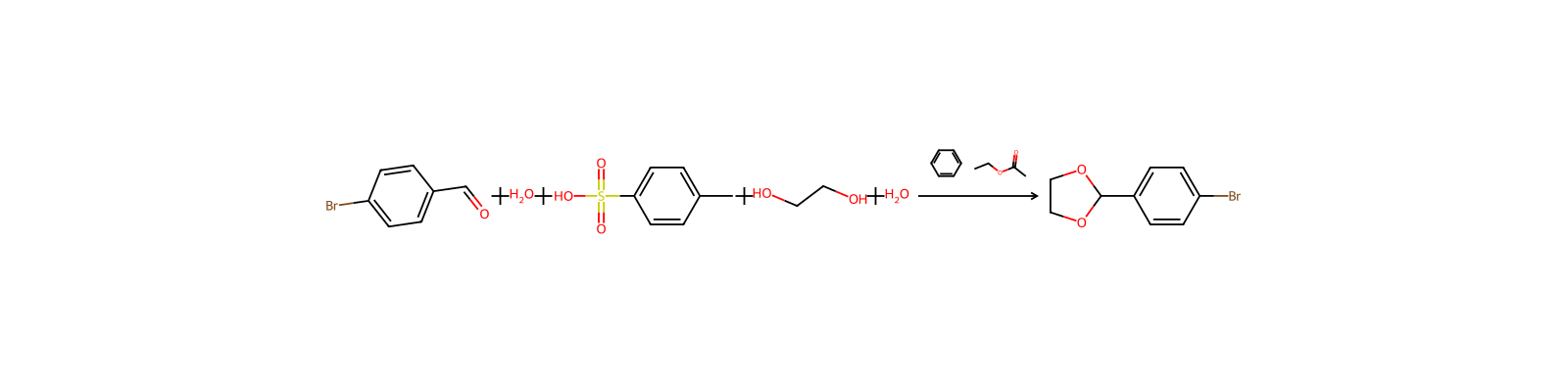
[Br:1][C:2]1[CH:9]=[CH:8][C:5]([CH:6]=[O:7])=[CH:4][CH:3]=1.O.C1(C)C=CC(S(O)(=O)=O)=CC=1.[CH2:22](O)[CH2:23][OH:24].O>C1C=CC=CC=1.C(OCC)(=O)C>[Br:1][C:2]1[CH:9]=[CH:8][C:5]([CH:6]2[O:24][CH2:23][CH2:22][O:7]2)=[CH:4][CH:3]=1Participants
7
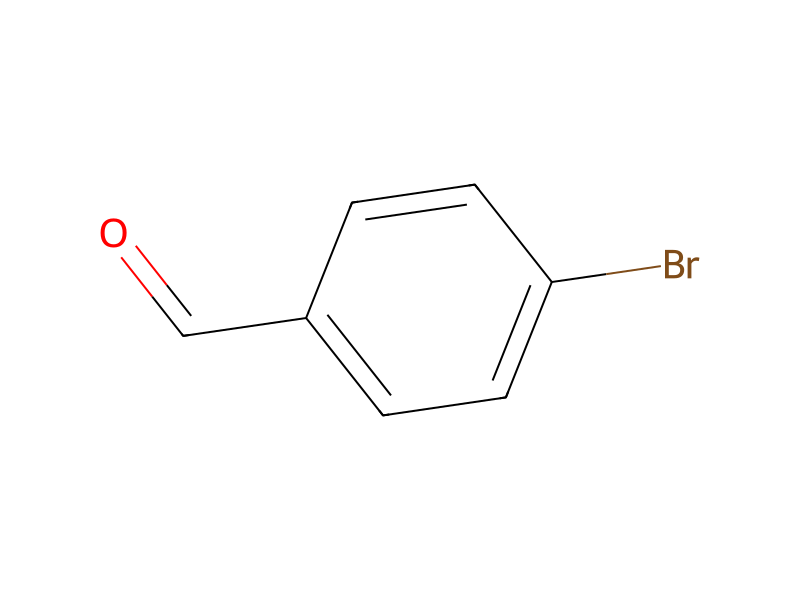
Reactant 4



Product 1

Reagents, catalysts & solvents 2


Procedure
4-Bromobenzaldehyde (3 g, 0.0162 mol) in benzene (60 mL) was treated with p-toluenesulfonic acid monohydrate (0.15 g, 0.79 mmol) and ethylene glycol (5 mL, 0.0896 mol). The reaction was refluxed under nitrogen with azeotropic removal of water. After 3 hours, the reaction was cooled to room temperature and diluted with an equal volume of ethyl acetate. This solution was washed twice with aqueous bicarbonate, dried over magnesium sulfate and concentrated under reduced pressure. A colorless oil was recovered. Yield=2.83 g (92%). TLC (5% ethyl acetate in hexanes) showed clean product, Rf=0.17.
Workup
- washThis solution was washed twice with aqueous bicarbonate
- dry with materialdried over magnesium sulfate
- concentrationconcentrated under reduced pressure
- customA colorless oil was recovered
Sources & evidence
- ORD record
- ord-c0b1f5fc553446359bccb5846409ec6d
- Source dataset
- uspto-grants-2006_08
- Patent number
- US07083986B2
Linked notes
Loading…