Reaction equation

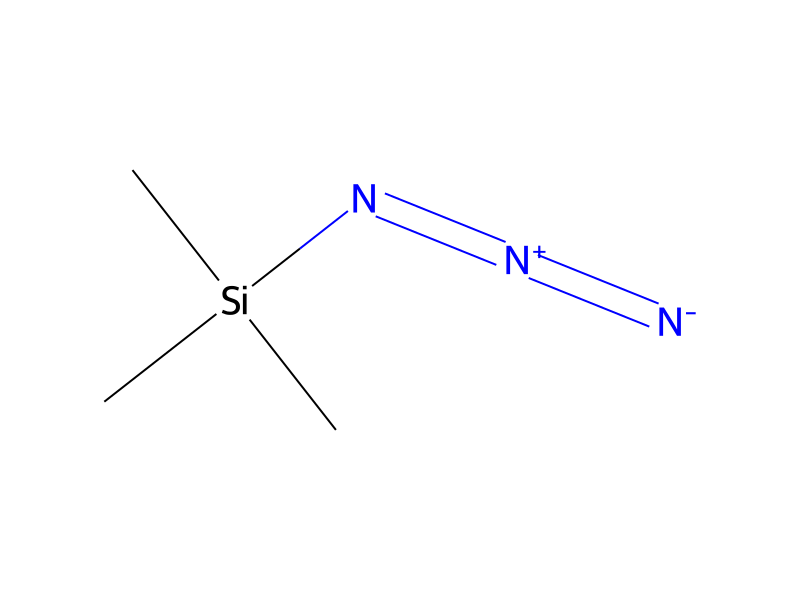
[Cl:1][C:2]1[CH:7]=[CH:6][C:5]([C:8]#[CH:9])=[CH:4][C:3]=1[CH2:10][NH:11][C:12](=[O:15])[O:13][CH3:14].CO.C[Si]([N:22]=[N+:23]=[N-:24])(C)C>CN(C)C=O.[Cu]I>[Cl:1][C:2]1[CH:7]=[CH:6][C:5]([C:8]2[NH:24][N:23]=[N:22][CH:9]=2)=[CH:4][C:3]=1[CH2:10][NH:11][C:12](=[O:15])[O:13][CH3:14]Participants
Reactant 3


Product 1

Reagents, catalysts & solvents 2


Conditions
- Temperature
- 100 °C
Procedure
To a solution of methyl N-[(2-chloro-5-ethynylphenyl)methyl]carbamate (i.e. the product of Step D) (0.43 g, 1.92 mmol) in N,N-dimethylformamide (3.9 mL) and methanol (0.4 mL) was added trimethylsilyl azide (0.38 mL, 2.89 mmol) and copper(I) iodide (0.019 g, 0.1 mmol). The reaction mixture was heated in a CEM Discover microwave apparatus at 100° C. for 8 h and then allowed to cool to room temperature. The reaction mixture was partitioned between ethyl acetate and aqueous sodium chloride, the layers were separated and the aqueous layer was extracted with ethyl acetate (2×). The combined organic layers were washed with water (3×), dried over magnesium sulfate, filtered and concentrated under reduced pressure to provide the title compound, a compound of the present invention, as a brown solid (0.30 g).
Workup
- temperatureto cool to room temperature
- customThe reaction mixture was partitioned between ethyl acetate and aqueous sodium chloride
- customthe layers were separated
- extractionthe aqueous layer was extracted with ethyl acetate (2×)
- washThe combined organic layers were washed with water (3×)
- dry with materialdried over magnesium sulfate
- filtrationfiltered
- concentrationconcentrated under reduced pressure
Sources & evidence
- ORD record
- ord-35a6f0c7e97740369673e373933633cd
- Source dataset
- uspto-grants-2014_09
- Patent number
- US08822521B2
Linked notes
Loading…