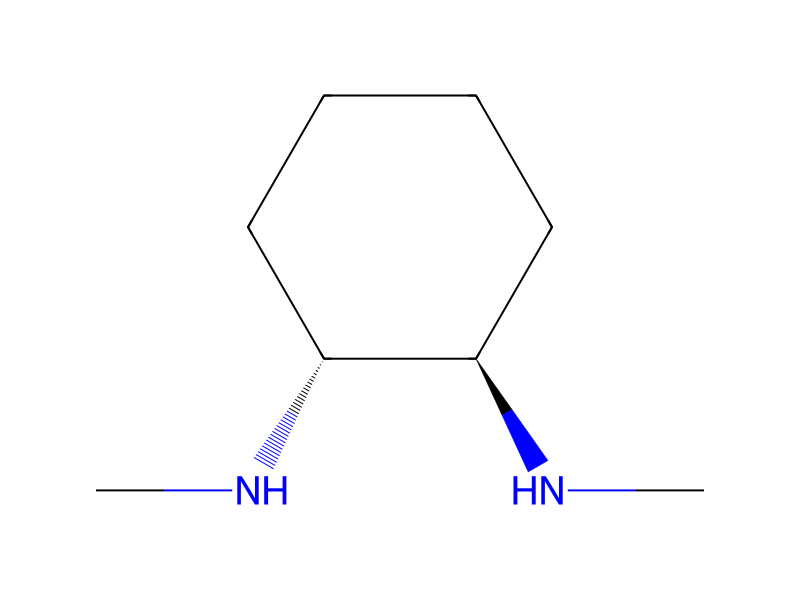
[O:1]=[C:2]1[CH:7]=[C:6]([CH2:8][NH:9][C:10](=[O:16])[O:11][C:12]([CH3:15])([CH3:14])[CH3:13])[CH:5]=[CH:4][NH:3]1.C([O-])([O-])=O.[K+].[K+].Br[C:24]1[CH:29]=[CH:28][N:27]=[C:26]([C:30]([F:33])([F:32])[F:31])[CH:25]=1.CN[C@@H]1CCCC[C@H]1NC>C1(C)C=CC=CC=1.[Cu]I.C(OCC)(=O)C>[O:1]=[C:2]1[CH:7]=[C:6]([CH2:8][NH:9][C:10](=[O:16])[O:11][C:12]([CH3:13])([CH3:15])[CH3:14])[CH:5]=[CH:4][N:3]1[C:24]1[CH:29]=[CH:28][N:27]=[C:26]([C:30]([F:33])([F:32])[F:31])[CH:25]=1To a reaction vessel containing a stir bar was charged with tert-butyl (2-oxo-1,2-dihydropyridin-4-yl)methylcarbamate 56-4 (72 mg, 0.32 mmol), CuI (12 mg, 0.06 mmol), and K2CO3 (88 mg, 0.64 mmol). The reaction vessel was evacuated and backfilled with nitrogen. A solution of 4-bromo-2-(trifluoromethyl)pyridine 56-5 (94 mg, 0.42 mmol) and (1R,2R)—N1,N2-dimethylcyclohexane-1,2-diamine (9 mg, 0.06 mmol) in toluene (3 mL) was added via syringe. The reaction was stirred at room temperature for 20 minutes, then 110° C. overnight. The reaction mixture was diluted into ethyl acetate and filtered through celite pad to remove salt. The filtrate was dried and the residue was purified by silica gel flash chromatography, and eluted with 50% ethyl acetate to give tert-butyl (2-oxo-1-(2-(trifluoromethyl)pyridin-4-yl)-1,2-dihydropyridin-4-yl)methylcarbamate 56-6. MS m/z 370.2 (M+1).
Loading…