HomeMCPWorkbenchSkills
HomeWorkbenchNotificationsMe
llms.txt · MCP GuidePrivacy Policy · Terms of Service · Supportv1.8.3
  1. Home
  2. /Reaction

Hydrochloric Acid → 2(R)-(3-chloro-4-methanesulfonyl-phenyl)-3-cyclopentyl-N-[5-((S)-2,2-dimethyl-[1,3]dioxolan-4-yl)-pyrazin-2-yl]-propionamide

HRID 719961
Print

Reaction equation

HRID 719961 reaction equation
[Cl:1][C:2]1[CH:3]=[C:4]([C@@H:12]([CH2:16][CH:17]2[CH2:21][CH2:20][CH2:19][CH2:18]2)[C:13]([OH:15])=O)[CH:5]=[CH:6][C:7]=1[S:8]([CH3:11])(=[O:10])=[O:9].C(Cl)(=O)C(Cl)=O.[CH3:28][C:29]1([CH3:41])[O:33][C@@H:32]([C:34]2[N:35]=[CH:36][C:37]([NH2:40])=[N:38][CH:39]=2)[CH2:31][O:30]1.N1C=CC=CC=1.Cl>CN(C)C=O.C(Cl)Cl>[Cl:1][C:2]1[CH:3]=[C:4]([C@@H:12]([CH2:16][CH:17]2[CH2:21][CH2:20][CH2:19][CH2:18]2)[C:13]([NH:40][C:37]2[CH:36]=[N:35][C:34]([C@H:32]3[CH2:31][O:30][C:29]([CH3:41])([CH3:28])[O:33]3)=[CH:39][N:38]=2)=[O:15])[CH:5]=[CH:6][C:7]=1[S:8]([CH3:11])(=[O:9])=[O:10]
ParticipantsConditionsProcedureWorkupSources & evidenceReaction notes

Participants

8

Reactant 5

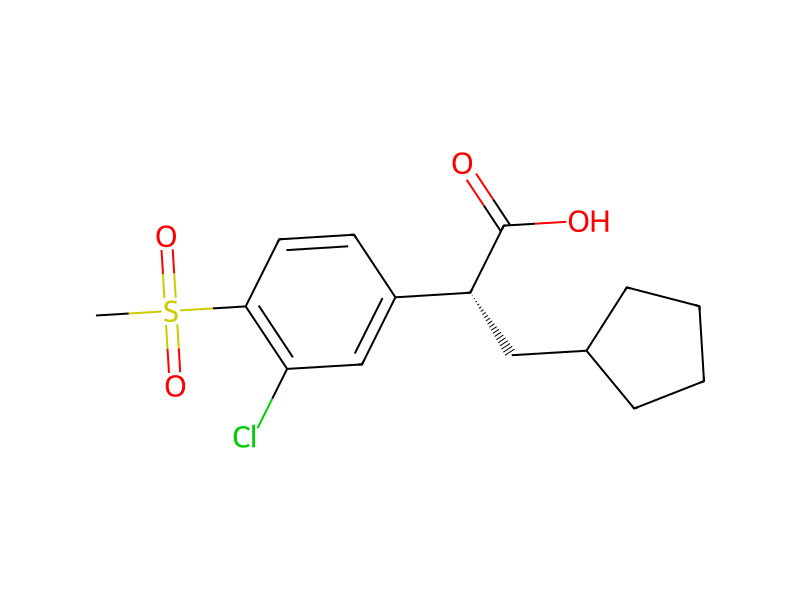
HCID 313Hydrochloric AcidHCID 1049PyridineHCID 65578Oxalyl chlorideHCID 12067655(R)-2-(3-Chloro-4-(methylsulfonyl)phenyl)-3-cyclopentylpropanoic acidHCID 533755855-((S)-2,2-dimethyl-[1,3]dioxolan-4-yl)-pyrazin-2-ylamine

Product 1

HCID 53375606
2(R)-(3-chloro-4-methanesulfonyl-phenyl)-3-cyclopentyl-N-[5-((S)-2,2-dimethyl-[1,3]dioxolan-4-yl)-pyrazin-2-yl]-propionamide
Yield 92.4%

Reagents, catalysts & solvents 2

HCID 6228DimethylformamideCatalystHCID 6344DichloromethaneSolvent2×

Conditions

Temperature
25 °C

Procedure

A solution of 2(R)-(3-chloro-4-methanesulfonyl-phenyl)-3-cyclopentyl-propionic acid (prepared as in Example 1, 6.29 g, 19.01 mmol) and N,N-dimethylformamide (2 drops) in methylene chloride (70 mL) was stirred at 2° C. and then treated with oxalyl chloride (4.15 mL, 45.7 mmol). The mixture was stirred at 2° C. for 5 min and at 25° C. for 15 min. The reaction mixture was then concentrated in vacuo. The residue was dissolved in benzene (25 mL), and the evaporation was repeated. The resulting acid chloride was dissolved in methylene chloride (40 mL), cooled to 0° C., and then treated with a solution composed of 5-((S)-2,2-dimethyl-[1,3]dioxolan-4-yl)-pyrazin-2-ylamine (3.65 g, 18.95 mmol), pyridine (4.6 mL, 56.9 mmol) and methylene chloride (40 mL). The mixture was stirred for 16 h without replenishing the cooling bath. The reaction mixture was then treated with a 1N aqueous hydrochloric acid solution (100 mL). The layers were separated, and the aqueous layer was extracted with methylene chloride (75 mL). The organic layers were washed with a saturated aqueous sodium bicarbonate solution (100 mL) and a saturated aqueous sodium chloride solution. The combined organic layers were dried over sodium sulfate, filtered, and concentrated in vacuo. Biotage chromatography (FLASH 40L, Silica, 1/1 ethyl acetate/hexanes) afforded 2(R)-(3-chloro-4-methanesulfonyl-phenyl)-3-cyclopentyl-N-[5-((S)-2,2-dimethyl-[1,3]dioxolan-4-yl)-pyrazin-2-yl]-propionamide (8.9 g, 92%) as a white foam: (ES)+-HRMS m/e calcd for C24H30ClN3O5S (M+H)+ 508.1668, found 508.1671.


Workup

  1. concentrationThe reaction mixture was then concentrated in vacuo
  2. dissolutionThe residue was dissolved in benzene (25 mL)
  3. customthe evaporation
  4. dissolutionThe resulting acid chloride was dissolved in methylene chloride (40 mL)
  5. temperaturecooled to 0° C.
  6. additiontreated with a solution
  7. stirringThe mixture was stirred for 16 h
  8. customThe layers were separated
  9. extractionthe aqueous layer was extracted with methylene chloride (75 mL)
  10. washThe organic layers were washed with a saturated aqueous sodium bicarbonate solution (100 mL)
  11. dry with materialThe combined organic layers were dried over sodium sulfate
  12. filtrationfiltered
  13. concentrationconcentrated in vacuo

Sources & evidence

ORD record
ord-a568b26e4cf642498e2f23d7cafe00e4
Source dataset
uspto-grants-2006_11
DOI
10.6084/m9.figshare.5104873.v1
Patent number
US07132425B2

Reaction notes

On this pageParticipantsConditionsProcedureWorkupSources & evidenceReaction notes