HomeMCPWorkbenchSkills
HomeWorkbenchNotificationsMe
llms.txt · MCP GuidePrivacy Policy · Terms of Service · Supportv1.8.3
  1. Home
  2. /Reaction

Triethylamine → 3-{4-[4-(2-benzyloxycarbamoylethyl)-phenoxy]-phenyl}-N,N-dimethyl-2-(toluene-4-sulfonylamino)-propionamide

HRID 748998
Print

Reaction equation

HRID 748998 reaction equation
[CH3:1][N:2]([CH3:36])[C:3]([CH:5]([NH:25][S:26]([C:29]1[CH:34]=[CH:33][C:32]([CH3:35])=[CH:31][CH:30]=1)(=[O:28])=[O:27])[CH2:6][C:7]1[CH:24]=[CH:23][C:10]([O:11][C:12]2[CH:17]=[CH:16][C:15]([CH2:18][CH2:19][C:20](O)=[O:21])=[CH:14][CH:13]=2)=[CH:9][CH:8]=1)=[O:4].ON1C2C=CC=CC=2N=N1.CCN=C=NCCCN(C)C.C(N(CC)CC)C.Cl.[CH2:66]([O:73][NH2:74])[C:67]1[CH:72]=[CH:71][CH:70]=[CH:69][CH:68]=1>CN(C=O)C>[CH2:66]([O:73][NH:74][C:20]([CH2:19][CH2:18][C:15]1[CH:16]=[CH:17][C:12]([O:11][C:10]2[CH:9]=[CH:8][C:7]([CH2:6][CH:5]([NH:25][S:26]([C:29]3[CH:34]=[CH:33][C:32]([CH3:35])=[CH:31][CH:30]=3)(=[O:27])=[O:28])[C:3]([N:2]([CH3:36])[CH3:1])=[O:4])=[CH:24][CH:23]=2)=[CH:13][CH:14]=1)=[O:21])[C:67]1[CH:72]=[CH:71][CH:70]=[CH:69][CH:68]=1

ParticipantsConditionsProcedureWorkupSources & evidenceReaction notes

Participants

7

Reactant 5

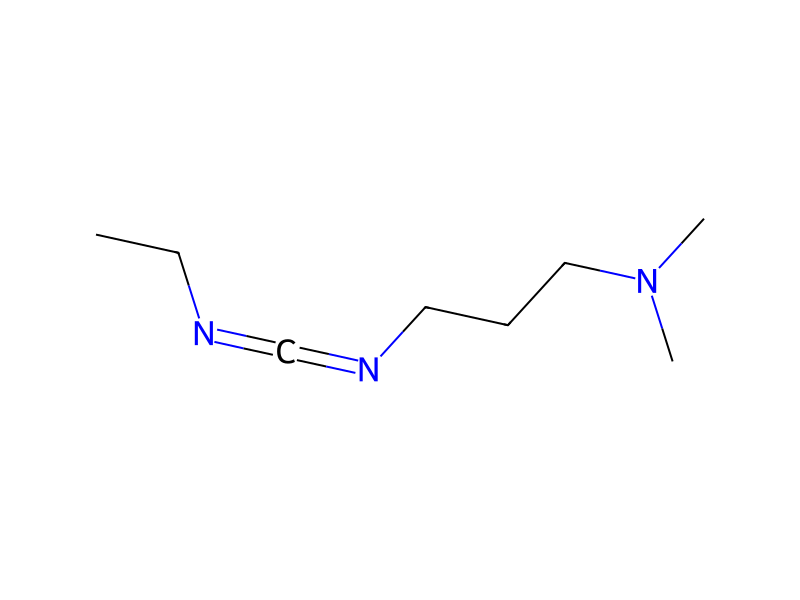
HCID 8471TriethylamineHCID 159081-Ethyl-3-(3'-dimethylaminopropyl)carbodiimideHCID 757711-HydroxybenzotriazoleHCID 102312Benzyloxyamine hydrochlorideHCID 159825783-(4-{4-[2-Dimethylcarbamoyl-2-(toluene-4-sulfonylamino)-ethyl]-phenoxy}-phenyl)-propionic acid

Product 1

HCID 72425149
3-{4-[4-(2-benzyloxycarbamoylethyl)-phenoxy]-phenyl}-N,N-dimethyl-2-(toluene-4-sulfonylamino)-propionamide
Yield 78.3%

Reagents, catalysts & solvents 1

HCID 6228DimethylformamideSolvent

Conditions

Temperature
2.5 °C

Procedure

The acid compound 25 (0.85 g, 1.66 mmol) was dissolved in dry DMF (20 mL) and cooled to 0-5° C. 1-Hydroxybenzotriazole (0.25 g, 1.82 mmol), EDCI (0.32 g, 1.66 mmol), and triethylamine (0.7 mL, 5.0 mmol) were added to the above mixture followed by stirring for 15 min. O-Benzylhydroxylamine hydrochloride (0.3 g, 1.83 mmol) was added and the mixture was allowed to come to room temperature and stirred for 18 h. The solvent was evaporated under reduced pressure and the residual oil was taken up in EtOAc (50 mL). The organic layer was extracted with 2.0 M HCl (1×10 mL), saturated NaHCO3 (1×10 mL), and brine (1×25 mL). The resulting EtOAc layer was dried and concentrated to yield the crude product. Flash chromatography on silica gel (hexanes:ethyl acetate—1:1 containing 1% acetic acid) yielded the desired benzyl hydroxamate 26 (0.8 g, 78%). 1H NMR (400 MHz, DMSO-d6): 8.06 (d, J=9.6 Hz, 1H), 7.54 (d, J=8.4 Hz, 2H), 7.30-7.36 (m, 5H), 7.29 (d, J=8.0 Hz, 2H), 7.19 (d, J=8.0 Hz, 2H), 7.09 (d, J=8.8 Hz, 2H), 6.86 (d, J=8.8 Hz, 2H), 6.81 (d, J=8.8 Hz, 2H), 4.72 (s, 2H), 4.26-4.32 (m, 1H), 2.75-2.82 (m, 3H), 2.68 (s, 3H), 2.57-2.63 (dd, J=13.6 and 7.6 Hz, 1H), 2.35 (s, 3H), 2.25 (t, J=7.2 Hz, 2H).

Workup

  1. customto come to room temperature
  2. stirringstirred for 18 h
  3. customThe solvent was evaporated under reduced pressure
  4. extractionThe organic layer was extracted with 2.0 M HCl (1×10 mL), saturated NaHCO3 (1×10 mL), and brine (1×25 mL)
  5. dry with materialThe resulting EtOAc layer was dried
  6. concentrationconcentrated
  7. customto yield the crude product

Sources & evidence

ORD record
ord-684c63de0fd740728189a740f4259ce0
Source dataset
uspto-grants-2008_07
DOI
10.6084/m9.figshare.5104873.v1
Patent number
US07399786B2

Reaction notes

On this pageParticipantsConditionsProcedureWorkupSources & evidenceReaction notes

