Reaction equation
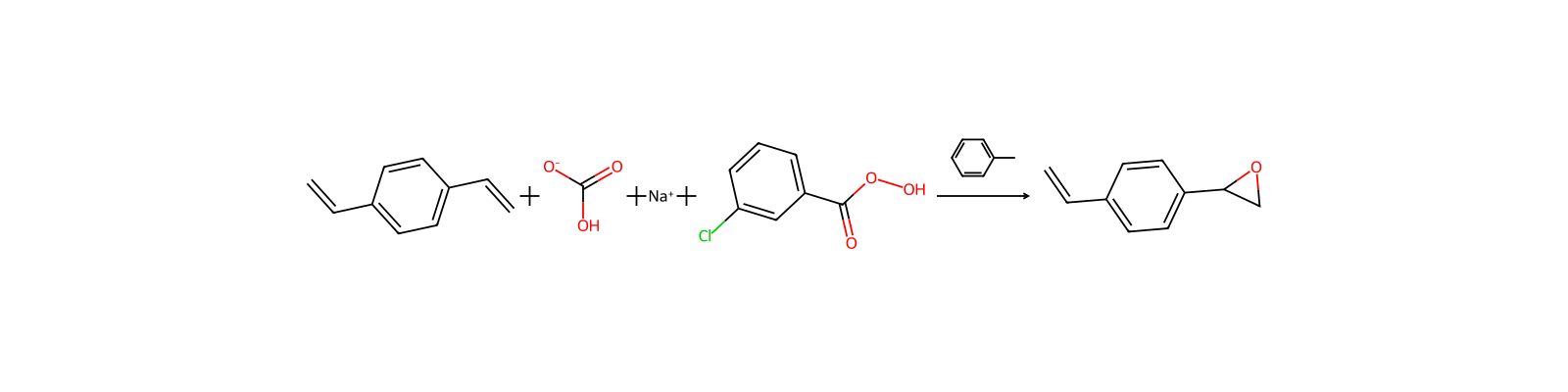
[CH:1]([C:3]1[CH:8]=[CH:7][C:6]([CH:9]=[CH2:10])=[CH:5][CH:4]=1)=[CH2:2].C(=O)([O-])[OH:12].[Na+].ClC1C=CC=C(C(OO)=O)C=1>C1(C)C=CC=CC=1>[CH:1]([C:3]1[CH:8]=[CH:7][C:6]([CH:9]2[O:12][CH2:10]2)=[CH:5][CH:4]=1)=[CH2:2]Participants
Reactant 3



Product 1

Reagents, catalysts & solvents 1

Procedure
Into a 1-liter reactor provided with a stirrer, and a thermometer, were added 25 g of p-divinylbenzene, 40 g of sodium hydrogencarbonate, and 400 ml of toluene. To the mixture, while being kept at 5° C. and stirred, was added dropwise a solution of 100 g (40% by weight) of m-chloroperbenzoic acid in toluene. The resulting mixture was stirred at 5° C. for 10 hours. After completion of the reaction, the reaction mixture was washed with aqueous sodium hydrogencarbonate solution, and dried over anhydrous magnesium sulfate. The mixture was filtered from the drying agent, then stripped of the toluene under reduced pressure, and purified by distillation to yield 65 g of 4-vinylstyrene oxide (1 Torr., 74° C.). In a similar manner, 3-vinylstyrene oxide was obtained from m-divinylbenzene.
Workup
- customInto a 1-liter reactor provided with a stirrer
- customwhile being kept at 5° C.
- stirringThe resulting mixture was stirred at 5° C. for 10 hours
- customAfter completion of the reaction
- washthe reaction mixture was washed with aqueous sodium hydrogencarbonate solution
- dry with materialdried over anhydrous magnesium sulfate
- filtrationThe mixture was filtered from the drying agent
- distillationpurified by distillation
Sources & evidence
- ORD record
- ord-bfd2dc5d57204b9da1f2586b838bee5a
- Source dataset
- uspto-grants-1988_07
- Patent number
- US04756989
Linked notes
Loading…