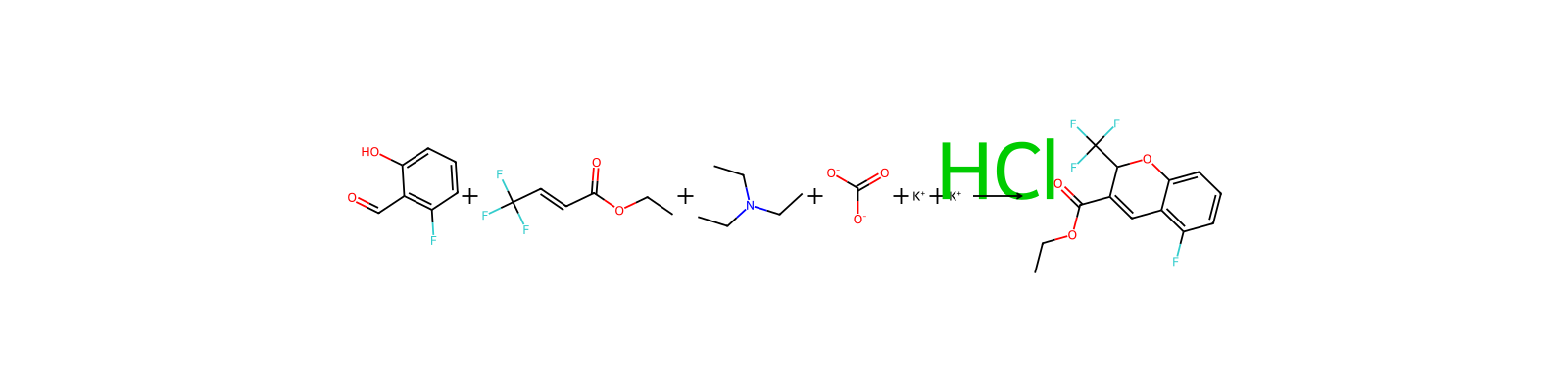
A mixture of 8.7 g (62 mmole) of 2-fluoro-6-hydroxybenzaldehyde, 18.6 mL (20.9 g, 124 mmole) of ethyl trifluorocrotonate and 17.3 mL (12.6 g, 124 mmole) of triethylamine was heated to reflux. After 3 hrs an additional 18.6 mL of ethyl trifluorocrotonate and 2 g of potassium carbonate was added and the mixture heated for 3 days. The mixture was allowed to cool, concd in vacuo, diluted with 1N HCl and extracted three times with diethyl ether. The combined extracts were washed with 1N HCl, brine, dried and concd to afford a dark oil. Kugelrohr distillation (0.2 torr, 50° C.) afforded 11.2 g (62%) of a white solid: mp 45.5-47.0° C.; 1H NMR (CDCl3/400 MHz) 1.33 (t, 3H, J=7.1 Hz), 4.30 (m, 2H), 5.68 (q, 1H, J=6.8 Hz), 6.70 (t, 1H, J=9.0 Hz), 6.76 (d, 1H, J=8.3 Hz), 7.24 (q, 1H, J=7.2 Hz), 7.92 (s, 1H); 19F NMR (CDCl3/ 400 MHz) −78.9 (d, 3F, J=7.7 Hz), −118.9 (m, 1F); 13C NMR (CDCl3/100 MHz) 14.2, 61.6, 70.7 (q, J=33.2 Hz), 108.7 (d, J=18.7 Hz), 109.2 (d, CH, J=20.6 Hz), 111.9 (d, CH, J=3.2 Hz), 117.0, 123.3 (q, J=287.5 Hz), 129.9 (d, CH, J=5.0 Hz), 133.2 (d, CH, J=10.3 Hz), 153.9, 158.5, 162.3 (d, J=253.5 Hz); MS(ES+) 291 (M+1, 100); MS(EI) 290 (M+, 13), 245 (18), 221 (100), 193 (99); HRMS (EI) m/z calcd for (C13H10O3F4) 290.0566, found 290.0589.