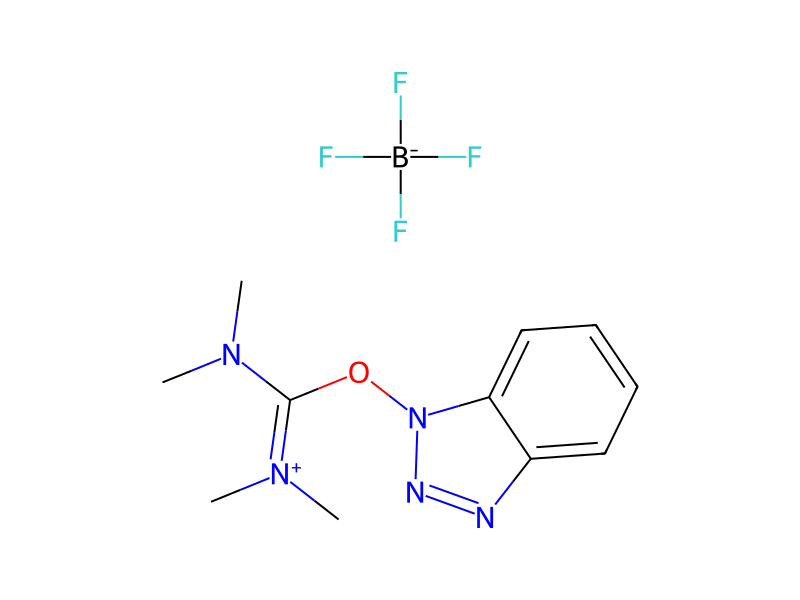
[Br:1][C:2]1[N:3]=[CH:4][C:5]([O:16][CH3:17])=[C:6]2[C:10]([C:11](=[O:15])[C:12]([OH:14])=O)=[CH:9][NH:8][C:7]=12.[N:18]1[CH:23]=[CH:22][CH:21]=[CH:20][C:19]=1[C:24]1[C:25]2[CH2:33][CH2:32][NH:31][CH2:30][C:26]=2[N:27]=[CH:28][N:29]=1.C(O)(C(F)(F)F)=O.CCN(C(C)C)C(C)C.CN(C(ON1N=NC2C=CC=CC1=2)=[N+](C)C)C.[B-](F)(F)(F)F>CN(C=O)C>[Br:1][C:2]1[N:3]=[CH:4][C:5]([O:16][CH3:17])=[C:6]2[C:10]([C:11](=[O:15])[C:12]([N:31]3[CH2:32][CH2:33][C:25]4[C:24]([C:19]5[CH:20]=[CH:21][CH:22]=[CH:23][N:18]=5)=[N:29][CH:28]=[N:27][C:26]=4[CH2:30]3)=[O:14])=[CH:9][NH:8][C:7]=12To a flask containing 2-(7-bromo-4-methoxy-1H-pyrrolo[2,3-c]pyridin-3-yl)-2-oxoacetic acid (0.264 g, 0.884 mmol) was added a solution of 4-(pyridin-2-yl)-5,6,7,8-tetrahydropyrido[3,4-d]pyrimidine, TFA (0.5 g, 1.149 mmol) in DMF (8 mL) followed by Hunig's Base (0.772 mL, 4.42 mmol) and finally TBTU (0.369 g, 1.149 mmol). After stirring the mixture at rt for 4 h, it was quenched with 10 mL of water and concentrated under reduced pressure. The residue was diluted with water (25 mL) and sat. aq. ammonium chloride (25 mL) added to the mixture. The mixture was extracted with dichloromethane (3×40 mL). The combined organic layers were washed with sat. aq. NaHCO3, dried with MgSO4, filtered and concentrated under reduced pressure. The residue was purified by BIOTAGE® flash chromatography using a 0-6% MeOH in dichloromethane gradient. The expected product, 1-(7-bromo-4-methoxy-1H-pyrrolo[2,3-c]pyridin-3-yl)-2-(4-(pyridin-2-yl)-5,6-dihydropyrido[3,4-d]pyrimidin-7(8H)-yl)ethane-1,2-dione (0.333 g, 0.675 mmol, 76% yield), was isolated as a brown solid. LC/MS: m/z 493 (M+H)+, 495.13 (M+3H)+, 2.177 min (method 3). 1H NMR (500 MHz, DMSO-d6) δ ppm 13.11 (br. s., 1H) 9.05-9.19 (m, 1H) 8.66-8.78 (m, 1H) 8.33-8.44 (m, 1H) 7.99-8.12 (m, 2H) 7.82 (s, 1H) 7.50-7.60 (m, 1H) 4.66-4.91 (m, 2H) 3.63-3.92 (m, 5H) 3.11-3.32 (m, 2H).