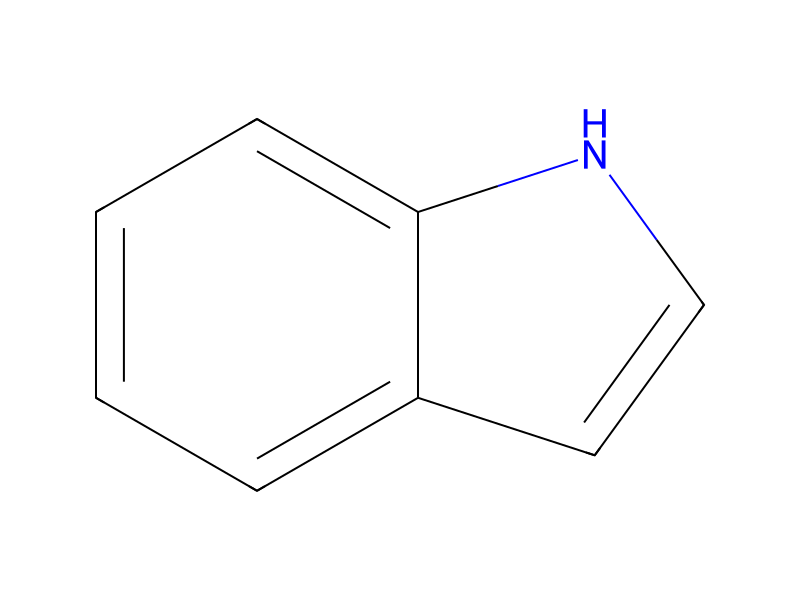
[NH:1]1[C:9]2[C:4](=[CH:5][CH:6]=[CH:7][CH:8]=2)[CH:3]=[CH:2]1.C([Mg]Br)C.Cl.Cl[CH2:16][C:17]1[CH:18]=[C:19]([CH:32]=[CH:33][CH:34]=1)[O:20][CH2:21][C:22]1[CH:31]=[CH:30][C:29]2[C:24](=[CH:25][CH:26]=[CH:27][CH:28]=2)[N:23]=1.C(=O)(O)[O-].[Na+]>O1CCCC1.C(OCC)C>[NH:1]1[C:9]2[C:4](=[CH:5][CH:6]=[CH:7][CH:8]=2)[C:3]([CH2:16][C:17]2[CH:18]=[C:19]([CH:32]=[CH:33][CH:34]=2)[O:20][CH2:21][C:22]2[CH:31]=[CH:30][C:29]3[C:24](=[CH:25][CH:26]=[CH:27][CH:28]=3)[N:23]=2)=[CH:2]1Indole (230 mg, 2.0 mmol) is dissolved in tetrahydrofuran (3 mL) and ethylmagnesium bromide (1 M, 2.0 mL, 2.0 mmol) is added and the reaction is heated for 2 h at 65° C. The free base of 2-(3-chloromethyl-phenoxymethyl)-quinoline hydrochloride (400 mg, 1.2 mmol, example 49) is prepard by partioning the material between ethyl ether and sodium bicarbonate and drying the organic phase with magnesium sulfate. This free base is dissolved in tetrahydrofuran (2 mL) and is added to the cooled indole/Grignard solution, along with catalytic tetrabutylammonium iodide. This mixture is heated 6 h at 65° C. The reaction is then cooled and partitioned between ethyl ether and ammonium chloride. The organic phase is washed with brine, dried over magnesium sulfate, concentrated and purified by column chromatography (silica, dichloromethane) to yield the title compound. MS (ESI) 365 (M+H)+.