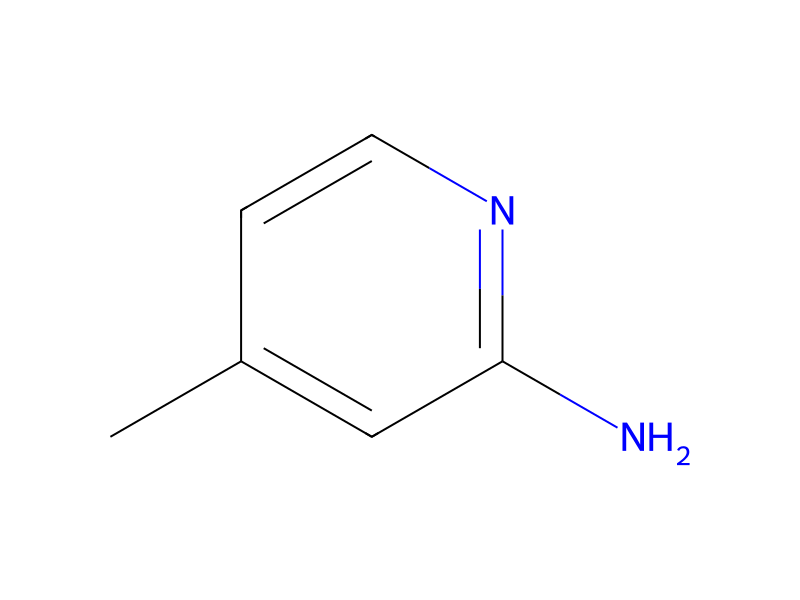
[CH3:1][C:2]1[CH:7]=[CH:6][N:5]=[C:4]([NH2:8])[CH:3]=1.[Li+].C[Si]([N-][Si](C)(C)C)(C)C.[CH3:19][C:20]1([CH3:36])[C:24]([CH3:26])([CH3:25])[O:23][B:22]([C:27]2[CH:35]=[CH:34][C:30]([C:31](Cl)=[O:32])=[CH:29][CH:28]=2)[O:21]1>C1COCC1.ClCCl>[CH3:1][C:2]1[CH:7]=[CH:6][N:5]=[C:4]([NH:8][C:31](=[O:32])[C:30]2[CH:29]=[CH:28][C:27]([B:22]3[O:23][C:24]([CH3:25])([CH3:26])[C:20]([CH3:36])([CH3:19])[O:21]3)=[CH:35][CH:34]=2)[CH:3]=1To a stirred solution of 4-methylpyridin-2-amine (7.86 mmol, 850 mg) in THF (50 mL) was added dropwise a solution of 1M LiHMDS in THF (8.0 mmol, 8 mL) at room temperature. After the reaction mixture turned dark green, a solution of 4-(4,4,5,5-tetramethyl-1,3,2-dioxaborolan-2-yl)benzoyl chloride (9.6 mmol, 2.56 g) in dichloromethane (55 mL) was added dropwise. The mixture was stirred at room temperature for 2.5 h and was then concentrated. 3% aq. Citric acid solution (18 mL) was added and the mixture was extracted with dichloromethane (2×15 mL). The combined organic layer was washed with 3% aq. citric acid solution, dried over magnesium sulfate, filtered and evaporated. The residue was dissolved in THF (15 mL) and 6M NaOH solution (15 mL) was added. The mixture was stirred for 4 h. at room temperature. Ethyl acetate was added and the layers were separated. The organic layer was washed with water and brine, dried over sodium sulfate, filtered and evaporated. The residue was purified by chromatography on silica (eluent: DCM/MeOH=98/2 to DCM/MeOH=95/5) to yield 1.1 g of N-(4-methylpyridin-2-yl)-4-(4,4,5,5-tetramethyl-1,3,2-dioxaborolan-2-yl)benzamide (40.7%).